AKITSORA GAMING

Treasure Sugoroku

Roll the dice, walk the board — land on the finish with your last roll and the buried gold comes up.

Treasure Sugoroku is a tall 4×5 map with 625 ways. 3/4 dice open a 24-square sugoroku board: roll, walk, dig — and land on the finish with your last roll for the buried treasure.

Demo play uses virtual credits with no monetary value.

RTP
96.68%
Volatility
Medium5.38
Max win
5,000× bet
Bonus buy
29.475 / 63.53× bet

In-game screens

Captured straight from the running game — real boards, real wins.

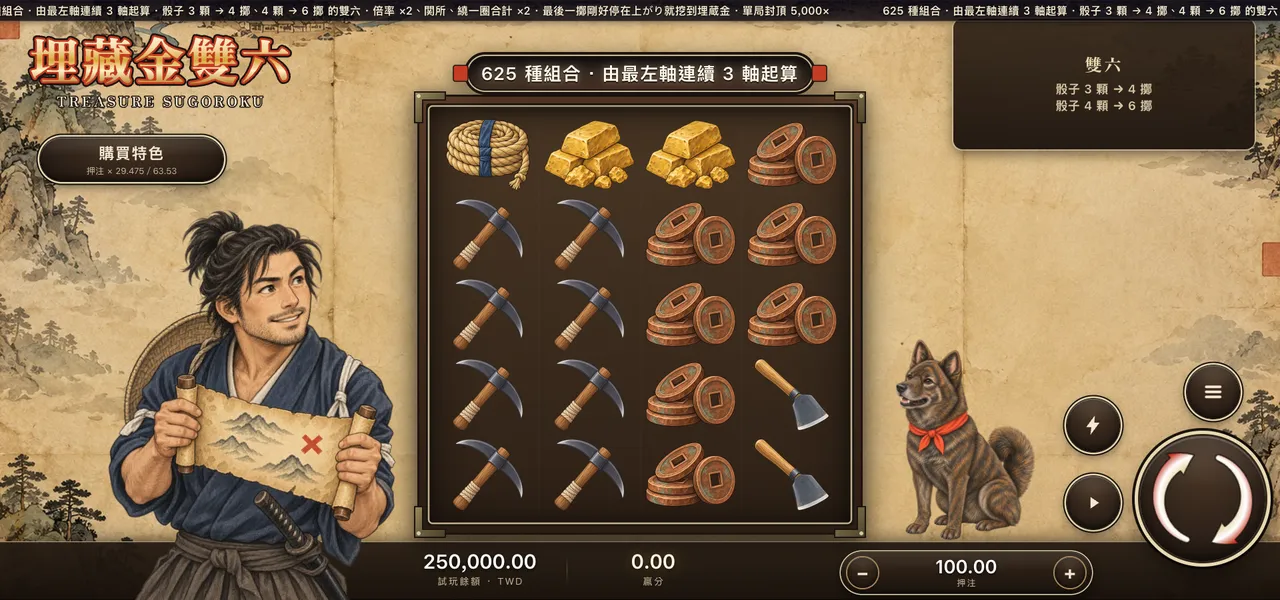
Treasure Sugoroku — The treasure map
The treasure map4 reels × 5 rows, 625 ways; the treasure hunter stands on the left and the Kai dog sits at the bottom right.
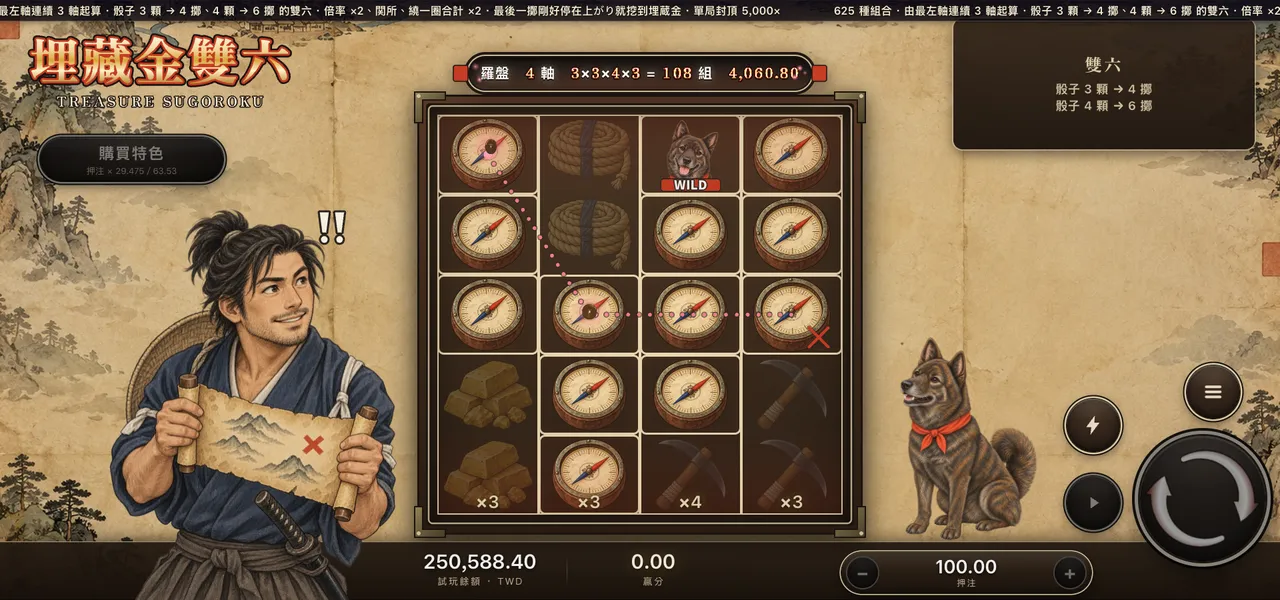
Treasure Sugoroku — Ways win
Ways win3 or more consecutive reels from the left; the counts on each reel multiply into the number of ways.
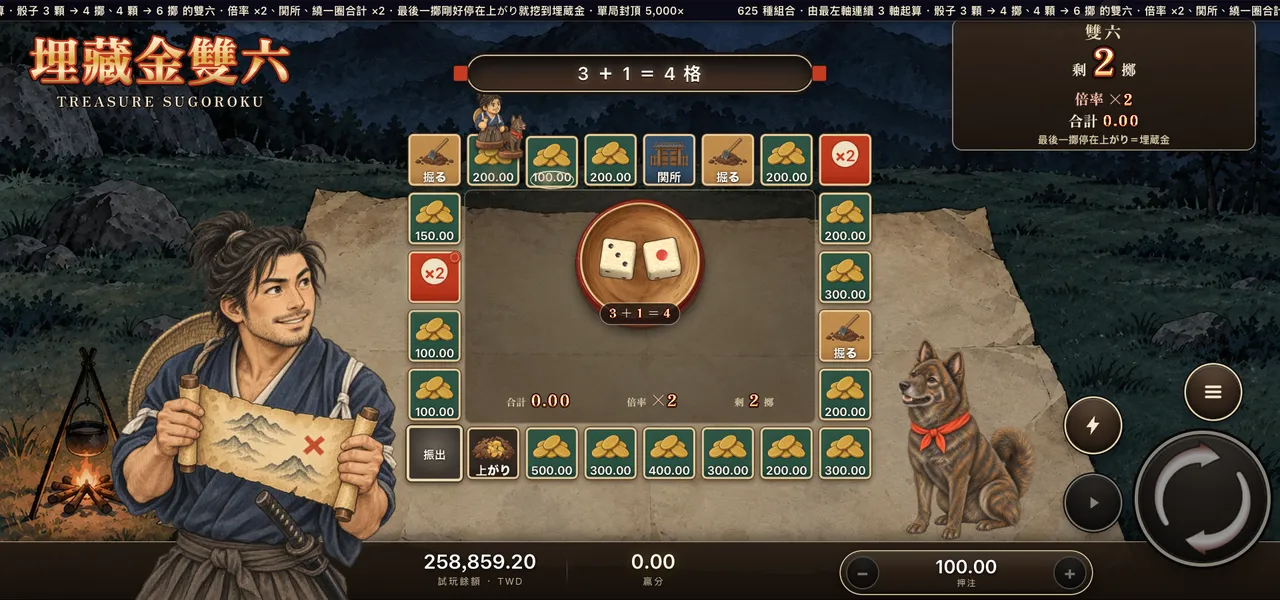
Treasure Sugoroku — Sugoroku
SugorokuA 24-square loop: the dice settle in the wooden bowl and the pawn hops square by square.
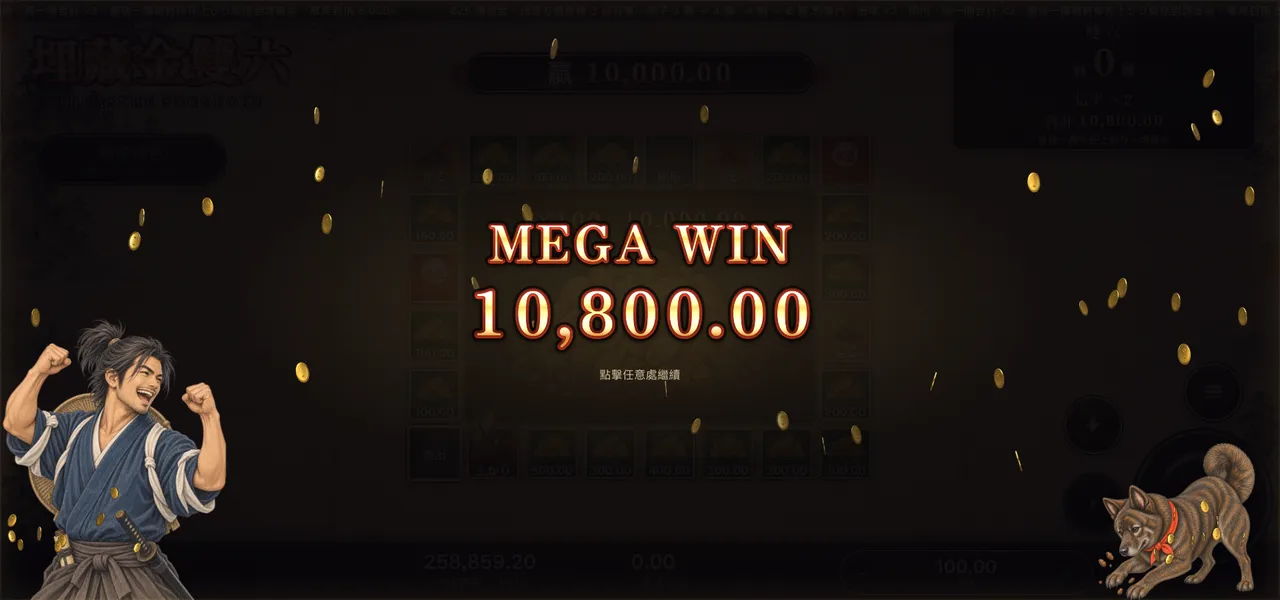
Treasure Sugoroku — Big win
Big winA single round is capped at 5,000× the bet.
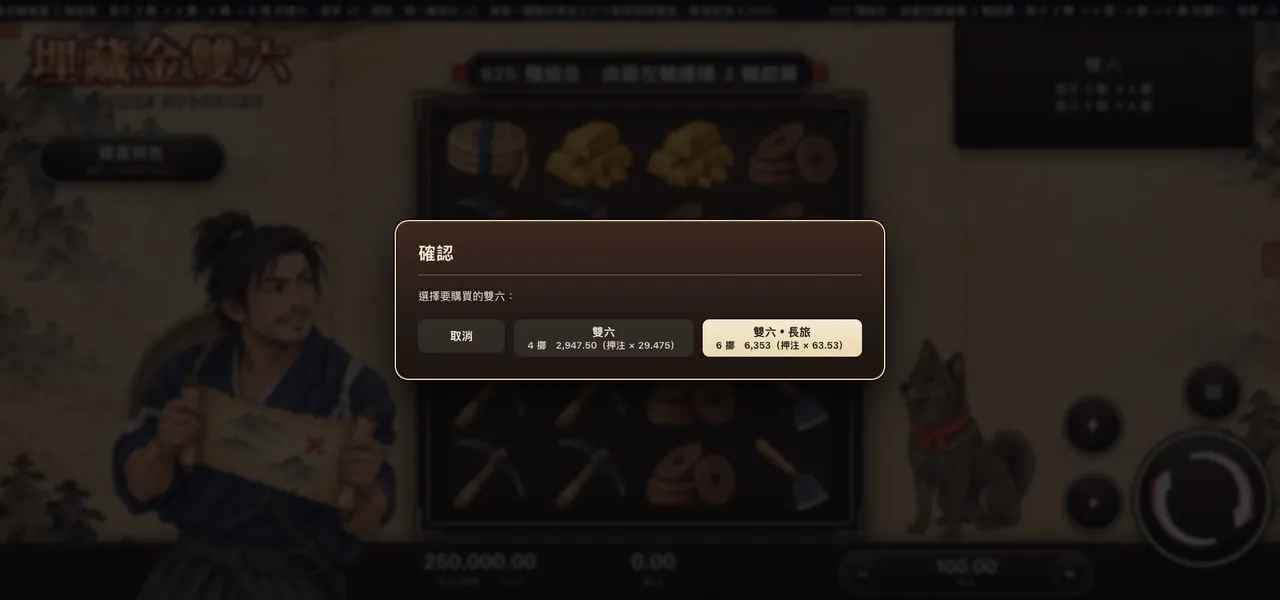
Treasure Sugoroku — Buy sugoroku
Buy sugorokuTwo tiers: 4 rolls at 29.475×, or the 6-roll long journey at 63.53×.
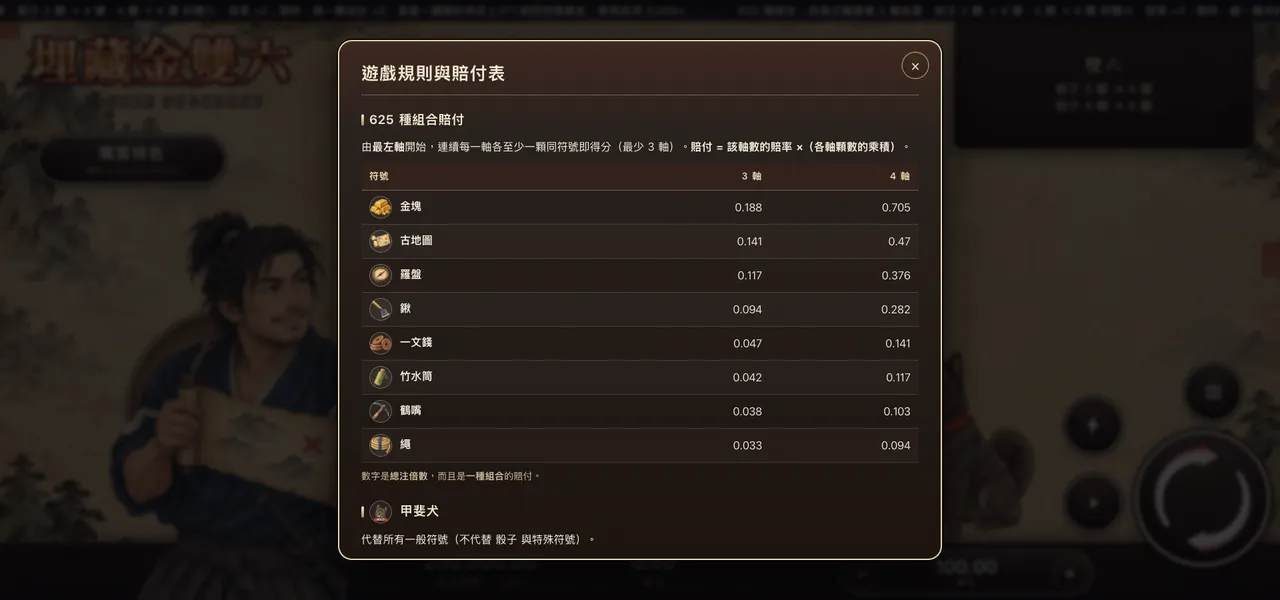
Treasure Sugoroku — In-game paytable
In-game paytableThe RGS supplies the squares and the prize and treasure ranges; this page reads the same game definition.

Specification

Type4 reels × 5 rows, 625 ways starting with 3 consecutive reels from the left, with a dice-roll board-game feature
Return to player (RTP)96.68%
Bonus buy RTP (Sugoroku)96.68%
Bonus buy RTP (Sugoroku · long journey)96.68%
VolatilityMedium (5.38)
Hit rate30.20%
Rounds winning ≥ 1× bet14.38%
Max win per round5,000× bet
Sugoroku (dice-roll board) frequency≈ 1 in 72.56 spins
RTP verificationExact solution: base game and feature computed exactly (not sampled); the max-win cap's 0.0000 percentage points are estimated by simulation; RTP 96.6808%

Game math specifications and the paytable are read at build time from the definitions shared with the server code. See Math version for the configuration shown; confirm any other version or operator-specific settings separately.

How wins work

  • The board is a tall treasure map: 4 reels × 5 rows, 625 ways, with no fixed paylines.
  • A symbol pays when it appears on 3 or more consecutive reels from the leftmost reel, multiplied by its count on each reel; the Kai dog is wild and appears on reels 2–4 only.
  • Dice are the scatter: 3/4 dice → 4/6 rolls of sugoroku. The board is a loop of 24 squares; each roll throws two dice and moves the pawn forward by their total, and the square it stops on pays on the spot.
  • Matching dice are a double: that roll doesn't count and you roll again. Passing or landing on the start completes a lap: the running total ×2.

Paytable

Values are total-bet multiples: a symbol's win = total bet × table value × the product of its counts on each reel. The Kai dog (wild) appears on reels 2–4 only and substitutes for regular symbols; dice do not pay. These are the same values shown in game.

Symbol3 reels4 reels
Gold nuggetHigh-pay 0.1880.705
Old mapHigh-pay 0.1410.47
CompassHigh-pay 0.1170.376
SpadeHigh-pay 0.0940.282
Mon coinLow-pay 0.0470.141
Bamboo flaskLow-pay 0.0420.117
PickaxeLow-pay 0.0380.103
RopeLow-pay 0.0330.094

Special symbols

Kai dog

Wild. Reels 2–4 only; substitutes for regular symbols, not for dice.

Dice

Scatter. No connection required and no pay of their own; 3/4 dice start 4/6 rolls of sugoroku.

Features

Roll and walk

The board has 16 cash squares (×1–×5 the total bet), 2 ×2 multiplier squares (everything collected afterwards doubles, up to ×4), 1 checkpoint (the running total ×2) and 3 dig sites. The dice tumble in a wooden bowl and the pawn hops square by square; the pips and the square are the RGS result.

Dig (pick one of three)

On a dig site, pick one of three mounds and dig up a prize (×2–×30 the total bet) × the multiplier. The three prizes are drawn from the same table and recorded the moment the pawn stops; your pick only opens one, and the other two are then revealed as buried. Autoplay also stops and waits for your pick.

Buried treasure

Land exactly on the finish with your last roll and the ground splits open: treasure ×50–×500, or the rare mountain of ōban ×5,000 (not multiplied). Landing on the finish before the last roll pays a scent of gold, ×4 × the multiplier.

Volatility and win distribution

RTP 96.68%, volatility 5.38. These rates use complete rounds started by a regular bet, including naturally triggered sugoroku; bonus buys are counted separately. The 30.20% hit rate counts any winning round; 14.38% of all rounds return at least the stake. Maximum win is 5,000× the bet per round.

Buy sugoroku (two tiers)

Pay 29.475× the bet to start 4 rolls of sugoroku (bonus-buy RTP 96.68%), or 63.53× for the 6-roll long journey (bonus-buy RTP 96.68%). Both are priced from the expected value of the purchase route.

Technical

Game codeaki_sugoroku
Math versionsg1
TechnologyHTML5, no plug-in; one client for desktop and mobile
ViewportLandscape with proportional scaling
In-game languageTraditional Chinese (additional languages on request)
CurrenciesTWD (others can be registered on request)
IntegrationTransfer wallet (Operator API v3), launch-token redirect

Sources & verification scope

This product specification is written and maintained by its developer, Akitsora Gaming (AKI電子 in Taiwan). Measurement methods and sample information for RTP, volatility and hit rate appear in the specification table. Sampled results have uncertainty; RTP describes long-run return, not an individual player or session outcome.

Internal simulations and tests are not independent certification. We do not currently hold GLI or BMM certification reports. Supply to a market requiring third-party certification depends on completing its requirements.

See slot game development and supply for integration and supply scope, About us for development and content responsibility, or contact us for a math summary, version confirmation or a correction to this page.

The story

Fiction and adapted settings written by Akitsora Gaming for this title, including invented dialogue and events. This is not a historical or folklore reference. The rules and specification tables define the gameplay and math.

A yellowed treasure map handed down from the last days of the shogunate,
bearing one line beside its vermilion seal: the gold lies at the finish of the sugoroku.

I. The Old Map and the Loyal Kai Dog

From the final days of the Tokugawa shogunate comes a weathered washi treasure map, stamped with a vermilion seal and a single cryptic line: the hidden gold rests at the finish of the sugoroku board. With his brindled Kai dog trotting faithfully at his side, a seasoned treasure hunter sets off into the mountain passes to follow the trail. Campfire embers flicker along the rocky pass as the hunter studies the faded ink strokes of the aged washi scroll.

The tall reel grid is that unrolled treasure map, filled with gold nuggets, brass compasses, old Edo coins, iron spades, pickaxes, and bamboo flasks, while the alert Kai dog acts as the wild symbol across the reels to connect winning ways from left to right. With his keen nose and steady stride, the loyal mountain dog is always ready to bridge the trail toward the next clue.

II. Rolling the Dice Around the Loop

Landing enough wooden dice anywhere on the map opens a traditional loop of sugoroku squares around the outer border. On each turn, two dice tumble inside a lacquer wooden bowl with a brisk clatter, and the hunter's pawn hops forward square by square with the dog close behind. Woodblock illustrations of gold-ingot squares, mountain checkpoints, and dig sites line the winding path around the board.

Every stop along the loop holds its own reward: cash squares pay on the spot, multiplier squares double future finds, rolling a double grants a free extra roll without spending a turn, and passing the starting square or landing on a checkpoint doubles the entire running total. Every throw of the bone dice brings a new twist to the journey as the multiplier climbs higher around the loop.

III. Three Mounds Waiting for the Spade

Scattered around the loop of the board are special dig sites marked with a spade. Whenever the pawn comes to rest on one of these squares, the mountain trail opens into a quiet forest clearing where three fresh mounds of earth sit waiting under the trees. Loose soil and mossy stones mark the spot where the shogunate's retainers hid their chests generations ago.

All three prizes are already buried underneath the moment your pawn stops; you choose one mound to dig up and multiply its treasure by your current board multiplier, before the remaining two mounds are uncovered to show what lay beneath them all along. Seeing all three mounds opened side by side proves that the mountain's treasures were waiting beneath the earth all along.

IV. A Mountain of Gold at the Finish

The greatest secret of the map awaits on the very last roll of the journey. Stopping on the finish square while rolls still remain in your hand awards a rich scent-of-gold prize multiplied by your board multiplier as the pawn continues around the loop. Every step closer to the final square heightens the suspense as the last dice roll tumbles inside the wooden bowl.

Yet if your final roll of the dice lands the pawn squarely on the finish, the shogunate's riddle comes true: the Kai dog barks and digs furiously, the ground splits wide open, and the buried treasure — even a mountain of golden ōban coins — rises into the light. Under the torchlight of the mountain pass, the centuries-old promise written beside the red seal is fulfilled in gleaming gold.

Want to spin Treasure Sugoroku yourself?

The demo needs no account — click and spin. For integration docs, the math summary or sandbox access, send us an email.

Demo play uses virtual credits with no monetary value.