AKITSORA GAMING

Paper Crests

One sheet of paper, one pair of scissors — fold, cut, and open up a family crest.

Paper Crests is a cluster cascade on a sheet of washi. Scissors cut 2×2 wild holes, and in the bonus the paper folds so matching crests merge and every hole is mirrored across the crease.

Demo play uses virtual credits with no monetary value.

RTP
96.35%
Volatility
Medium-high7.63
Max win
2,000× bet
Bonus buy
77.76× bet

In-game screens

Captured straight from the running game — real boards, real wins.

Paper Crests — An afternoon in the tatami room
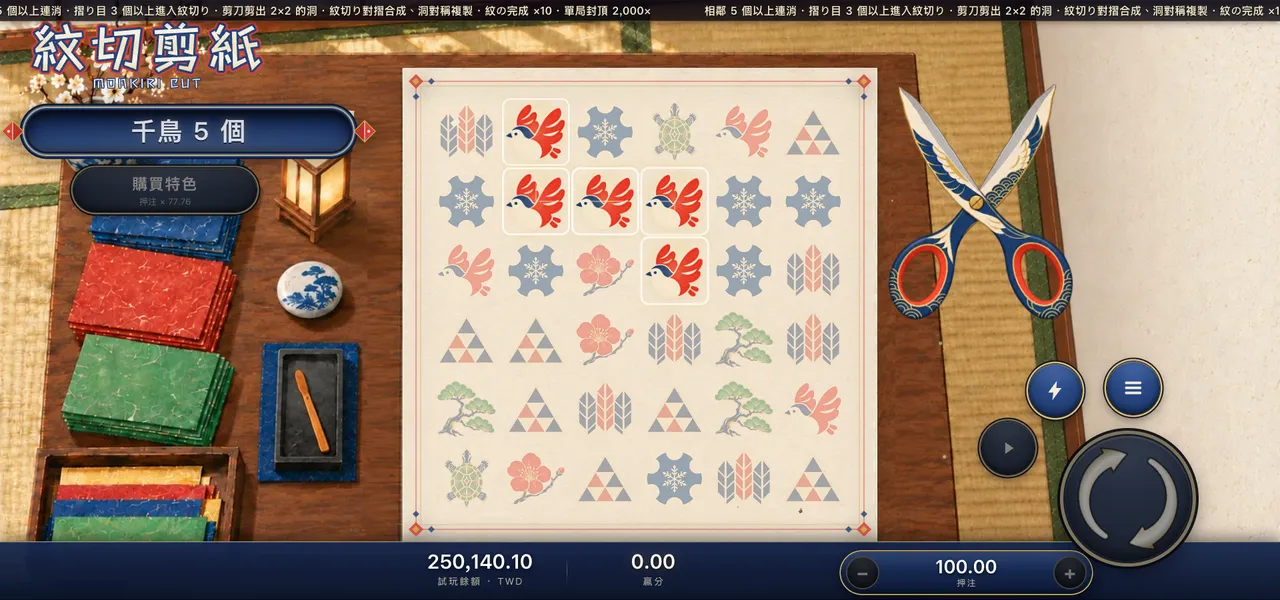
An afternoon in the tatami roomA 6×6 sheet of washi on a low table, where 5+ touching crests pay and the scissors wait beside it.
Paper Crests — A cluster
A clusterMatching crests join into a cluster and are removed, the ones above drop and the cascade continues.
Paper Crests — Kirigami
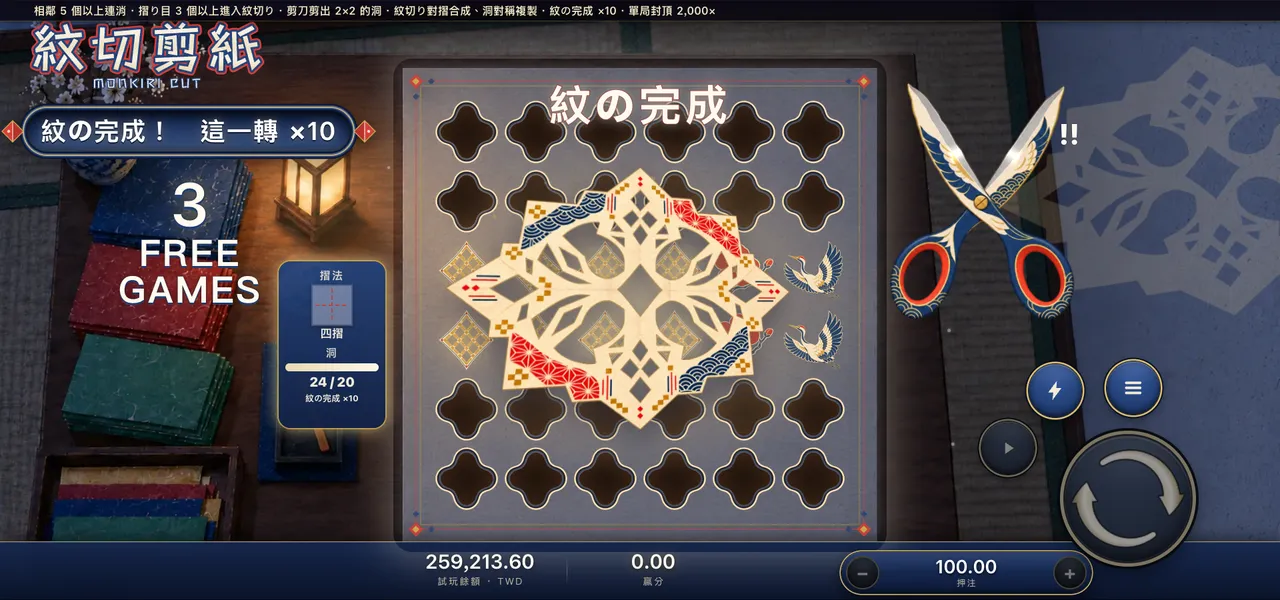
KirigamiThe paper folds, overlapping crests merge and upgrade, and the holes are mirrored across the crease.
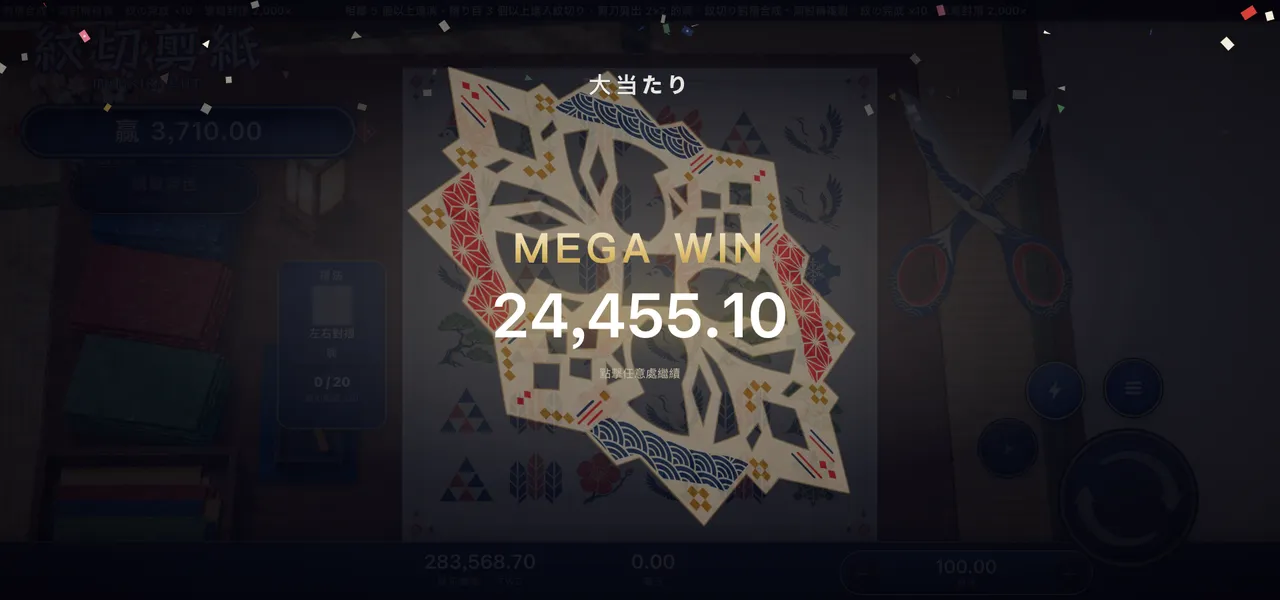
Paper Crests — Big win
Big winA single round is capped at 2,000× the bet.
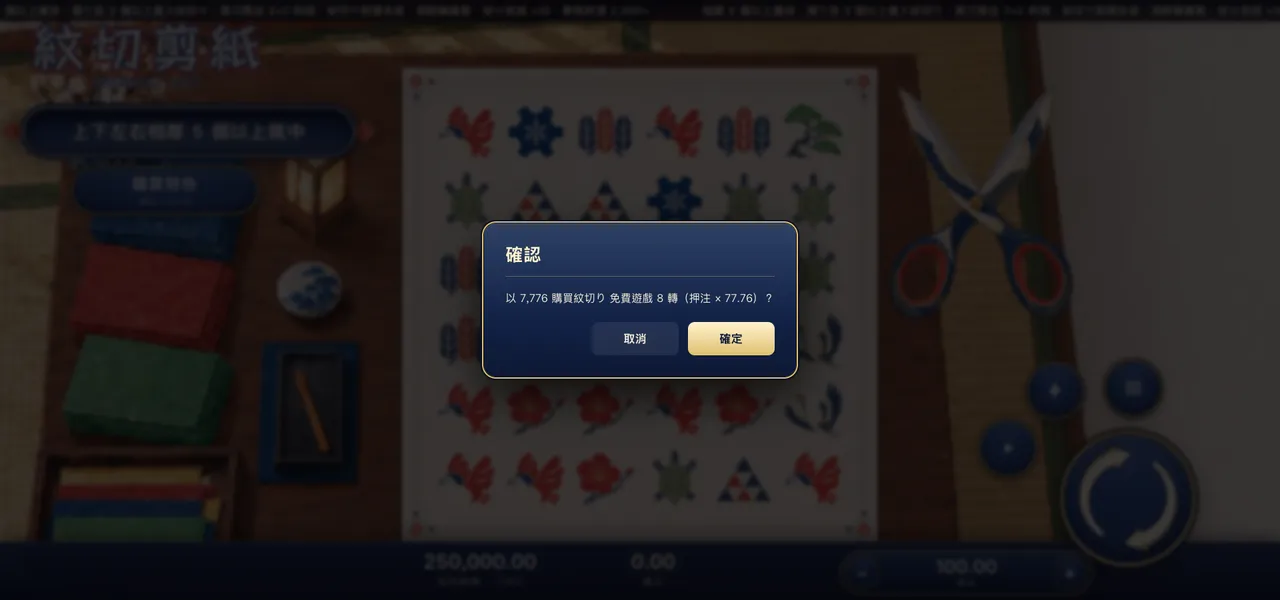
Paper Crests — Bonus buy
Bonus buy×77.76 straight into Kirigami (8 spins).
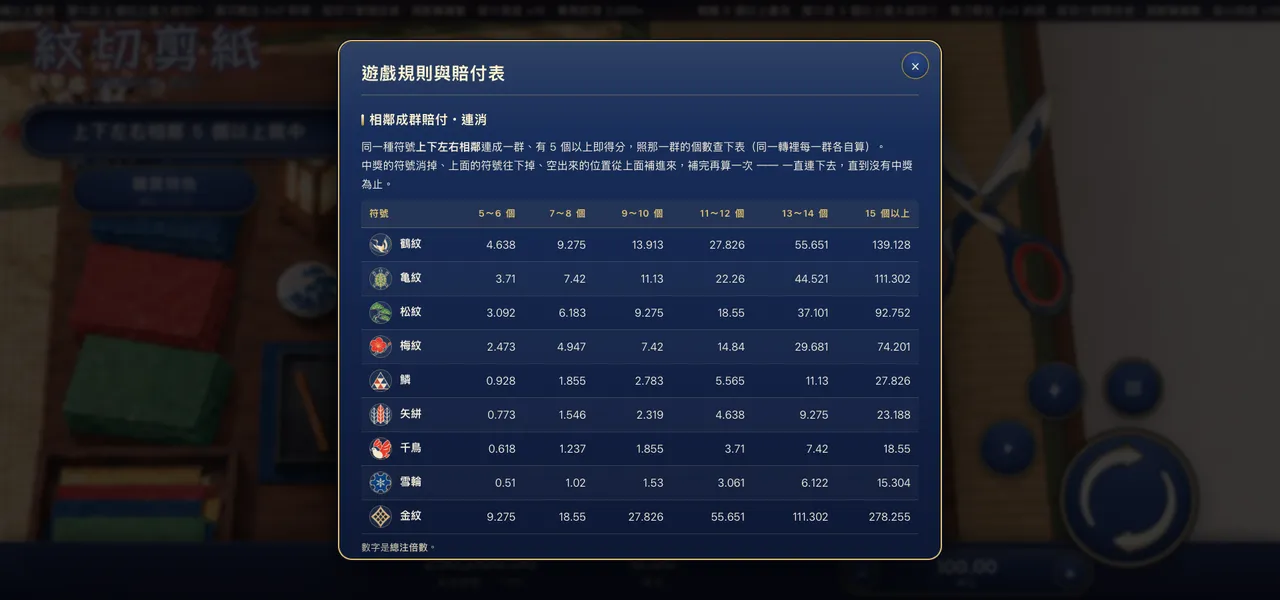
Paper Crests — In-game paytable
In-game paytableFrom the same game definition as this page: served by the RGS in game, read at build time here.

Specification

Type6×6 cluster pays with cascades (5+ touching up, down, left or right)
Return to player (RTP)96.35%
Bonus buy RTP96.35%
VolatilityMedium-high (7.63)
Hit rate32.08%
Rounds winning ≥ 1× bet16.48%
Max win per round2,000× bet
Kirigami (free spins) frequency≈ 1 in 181.07 spins
Calibration sample2,000,000,000 spins, standard error 0.02%

Game math specifications and the paytable are read at build time from the definitions shared with the server code. See Math version for the configuration shown; confirm any other version or operator-specific settings separately.

How wins work

  • The grid is a 6×6 sheet of washi with no paylines: 5 or more matching crests touching up, down, left or right form a cluster and pay by their count.
  • Winning crests are removed, the ones above drop down, new ones fill from the top and the grid pays again — until nothing wins.
  • Scissors do not pay: whenever they land (on the stopped grid or in a cascade) they cut a 2×2 hole where they sit. Holes are Wild and substitute for any regular crest in a cluster (not counted).
  • Creases do not pay: 3 or more on the grid once the cascades stop start Kirigami (free spins).

Paytable

Values are multiples of the total bet per cluster: win = total bet × table value (by the number of matching crests in the cluster; holes connect but are not counted). On a spin where the crest is complete, the whole spin's win is multiplied by 10.

Symbol5–67–89–1011–1213–1415+
Crane crestHigh-pay 4.6389.27513.91327.82655.651139.128
Tortoise crestHigh-pay 3.717.4211.1322.2644.521111.302
Pine crestHigh-pay 3.0926.1839.27518.5537.10192.752
Plum crestHigh-pay 2.4734.9477.4214.8429.68174.201
Scale patternLow-pay 0.9281.8552.7835.56511.1327.826
Arrow-feather patternLow-pay 0.7731.5462.3194.6389.27523.188
Plover patternLow-pay 0.6181.2371.8553.717.4218.55
Snow-ring patternLow-pay 0.511.021.533.0616.12215.304
Gold crestHigh-pay 9.27518.5527.82655.651111.302278.255

Special symbols

Scissors

Does not pay. Cuts a 2×2 hole wherever it lands; in Kirigami the holes are mirrored across the crease.

Hole

Wild; substitutes for any regular crest in a cluster (not counted) and is removed with the win. In Kirigami, 20 or more holes on the stopped grid complete the crest.

Crease

Scatter, does not pay and is never cut. 3 or more on the grid once the cascades stop start Kirigami; 3 or more during the bonus add 3 spins.

Features

Scissors cut holes

Scissors cut a 2×2 hole with their own cell as the top-left corner (shifted back at the right or bottom edge of the sheet); a crease cell is never cut. Holes are Wild and only join crests together; when a win uses them they are removed with it. Scissors that drop in during a cascade cut too, often joining a new cluster.

Kirigami — fold and merge

On every Kirigami spin the paper is folded first — left–right, top–bottom, four-fold. Once the reels stop, any two overlapping cells holding the same crest both upgrade one level: each pattern becomes its matching crest, and the four crests become the gold crest. A four-fold is left–right then top–bottom, so a cell matched both times upgrades twice.

Mirrored holes — the crest is complete

In Kirigami every hole the scissors cut is mirrored across this spin's crease (one pair of scissors can cut up to four holes on a four-fold), opening into a symmetrical crest. If the stopped grid holds 20 or more hole cells after cutting, the crest is complete and the whole spin's win is ×10.

Creases — Kirigami free spins

3/4/5 creases award 8/10/12 spins of Kirigami; 3 or more during the bonus add 3 spins. Every spin is a fresh sheet: folding, merging, cutting and completing all happen within that spin.

Volatility and positioning

Volatility 7.63. The 32.08% hit rate counts any winning round; 16.48% of all rounds return at least the stake. Cascades and scissor-cut holes carry about 56% of the RTP in the base game; Kirigami comes about once every 181.07 spins, merging crests into bigger ones as mirrored holes spread across the sheet. A single round is capped at 2,000× the bet and ends when it hits the cap. This describes the product's positioning and does not guarantee any single session.

Bonus buy

Pay 77.76× the bet to start Kirigami (8 spins). The price follows the expected value of that purchase route (bonus-buy RTP 96.35%) and is calibrated separately from regular play.

Technical

Game codeaki_monkiri
Math versionmk1
TechnologyHTML5, no plug-in; one client for desktop and mobile
ViewportLandscape with proportional scaling
In-game languageTraditional Chinese (additional languages on request)
CurrenciesTWD (others can be registered on request)
IntegrationTransfer wallet (Operator API v3), launch-token redirect

Sources & verification scope

This product specification is written and maintained by its developer, Akitsora Gaming (AKI電子 in Taiwan). Measurement methods and sample information for RTP, volatility and hit rate appear in the specification table. Sampled results have uncertainty; RTP describes long-run return, not an individual player or session outcome.

Internal simulations and tests are not independent certification. We do not currently hold GLI or BMM certification reports. Supply to a market requiring third-party certification depends on completing its requirements.

See slot game development and supply for integration and supply scope, About us for development and content responsibility, or contact us for a math summary, version confirmation or a correction to this page.

The story

Fiction and adapted settings written by Akitsora Gaming for this title, including invented dialogue and events. This is not a historical or folklore reference. The rules and specification tables define the gameplay and math.

Afternoon sunlight slants through the paper screen onto a low wooden table.
Fold a sheet of washi, make a single cut, and unfold a symmetrical family crest.

I. The Edo Art of Crest Cutting

During the Edo period, townsfolk and children delighted in a quiet pastime called monkiri—the art of cutting family crests from paper. Without ink or brush, a craftsperson simply took a square of dyed handmade washi, folded it neatly, snipped a few shapes with iron blades, and unfolded a crisp heraldic emblem.

Cranes, tortoises, pine diamonds, plum blossoms, scales, arrow feathers, plovers, and snow rings all emerged from simple geometry. The square grid of the game is that sheet of washi laid flat on a walnut table, where matching crests touching orthogonally form clusters and clear.

II. Iron Scissors and Wooden Grain

Spinning among the printed crests are pairs of traditional U-shaped iron scissors. Whether they land on the initial drop or fall in during a cascade, the spring blades immediately snip a two-by-two square hole out of the paper with their own cell as the corner.

Through those cut-out holes the warm wood grain of the low table shows through clearly. Every hole cell acts as a wild symbol that joins adjacent crests into larger clusters across the sheet, vanishing cleanly with the paper scraps once it has helped complete a win.

III. Folding Along the Crease

Faint white creases also appear across the sheet, and gathering enough of them once the cascades settle begins the Kirigami free spins. Every spin in the bonus starts with a fresh sheet of washi that folds before the symbols are evaluated—left to right, top to bottom, or quartered in a four-fold.

Wherever two cells folded on top of one another hold the exact same symbol when the grid stops, both overlapping cells upgrade one tier from a simple pattern into a formal crest, or from a family crest into the top-paying gold crest.

IV. Mirrored Cuts and the Finished Crest

Cutting folded paper is where the magic of monkiri truly shines: in Kirigami, every hole snipped by the scissors is automatically mirrored across the active fold lines, so a single pair of scissors on a four-fold sheet can open up four symmetrical windows of wilds at once.

If enough hole cells lie open across the paper when the sheet unfolds, the crest is complete and the entire spin's payout is multiplied before the cascades even begin. It is the game's theme, not a promise: folded paper and heraldic crests are traditional craft, while every spin's outcome is still decided by the RGS random number generator.

Want to spin Paper Crests yourself?

The demo needs no account — click and spin. For integration docs, the math summary or sandbox access, send us an email.

Demo play uses virtual credits with no monetary value.