
AKITSORA GAMING

Karate Break

One punch breaks one stack of roof tiles — only the broken tiles count.

Karate Break is a dojo tile-breaking grid: each punch smashes the top of one stack, only the broken tiles pay, every win earns another punch, and grading climbs to a five-stack break.

Demo play uses virtual credits with no monetary value.

RTP
96.62%
Volatility
Very high15.57
Max win
10,000× bet
Bonus buy
143.35 / 525.95× bet

In-game screens

Captured straight from the running game — real boards, real wins.

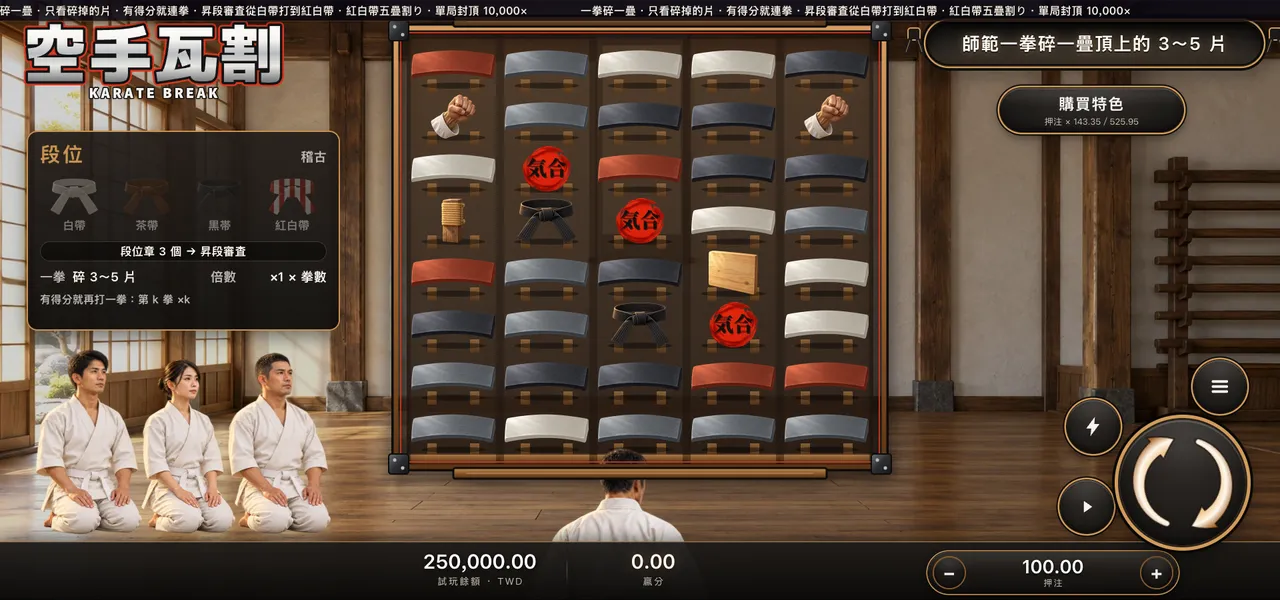
Karate Break — Five stacks in the dojo
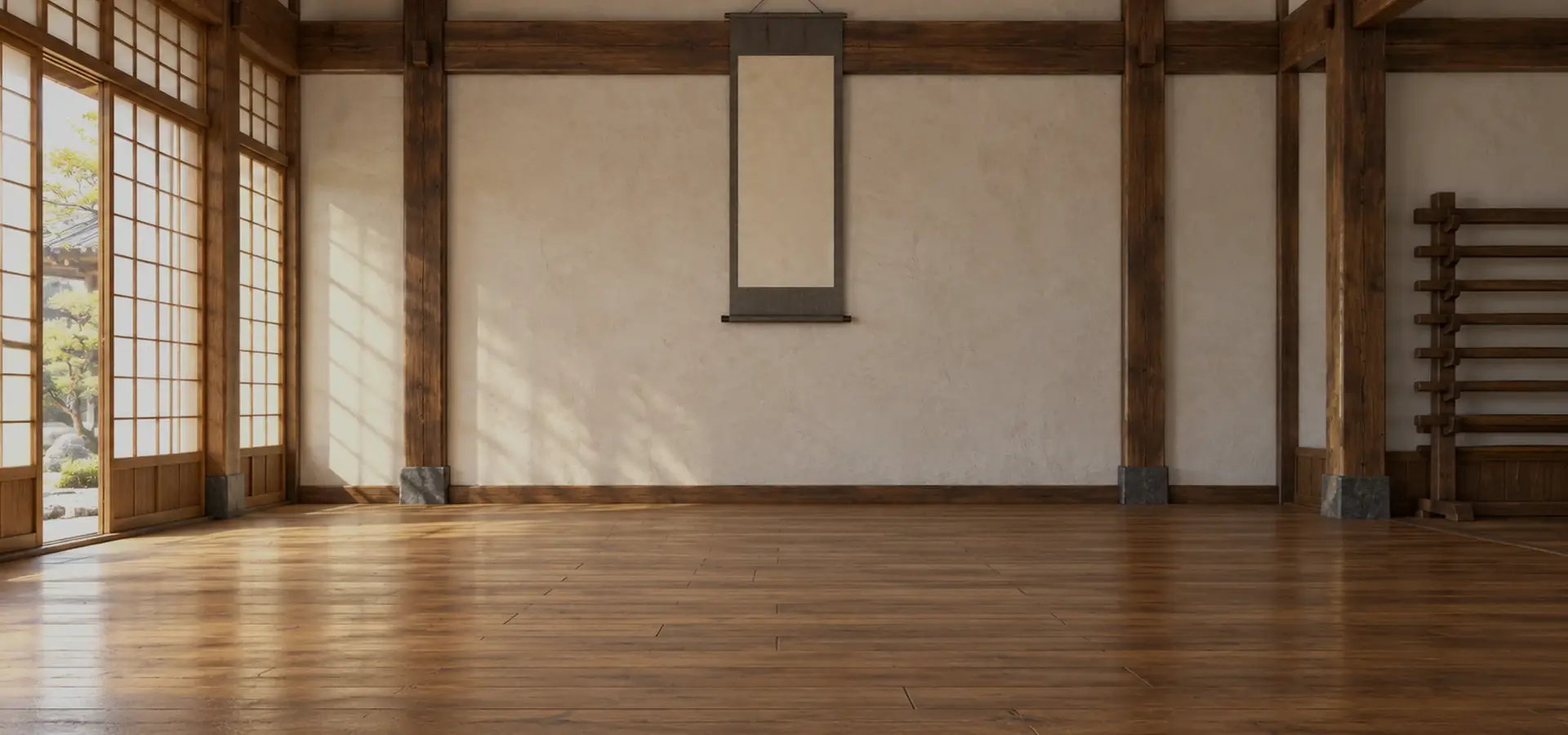
Five stacks in the dojo5 stacks of roof tiles sit on wooden stands; the master breathes with his back to us while students kneel to the left.
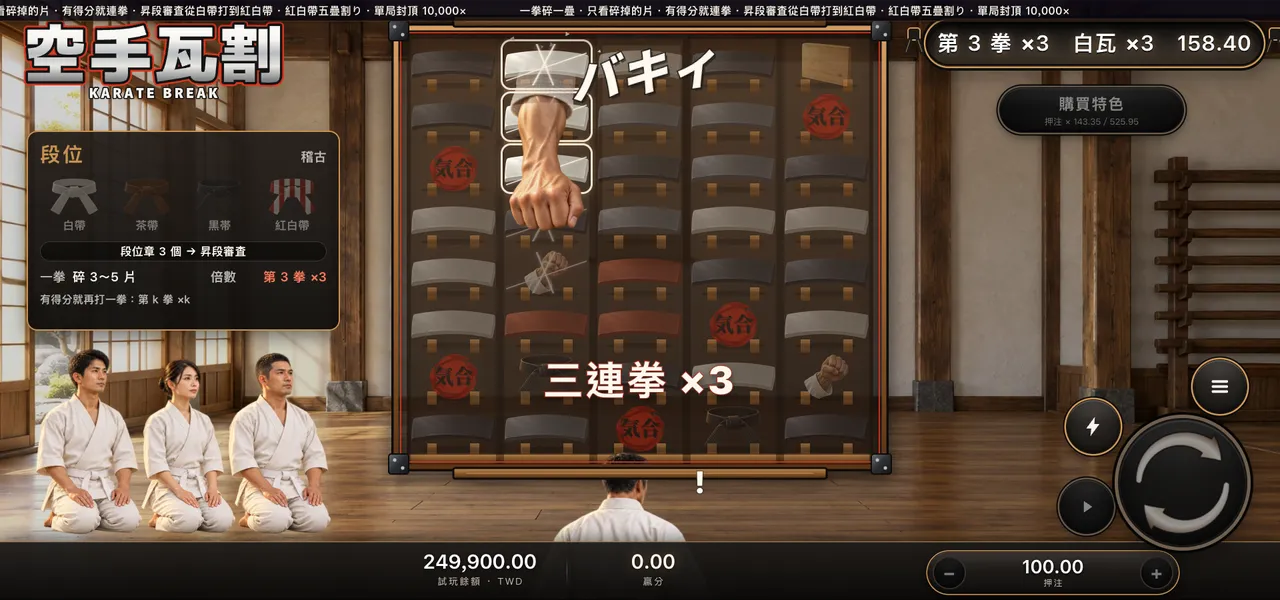
Karate Break — Chain punches
Chain punchesA punch breaks 3–5 tiles; 3 of a kind pay, and every win earns another punch at ×k.
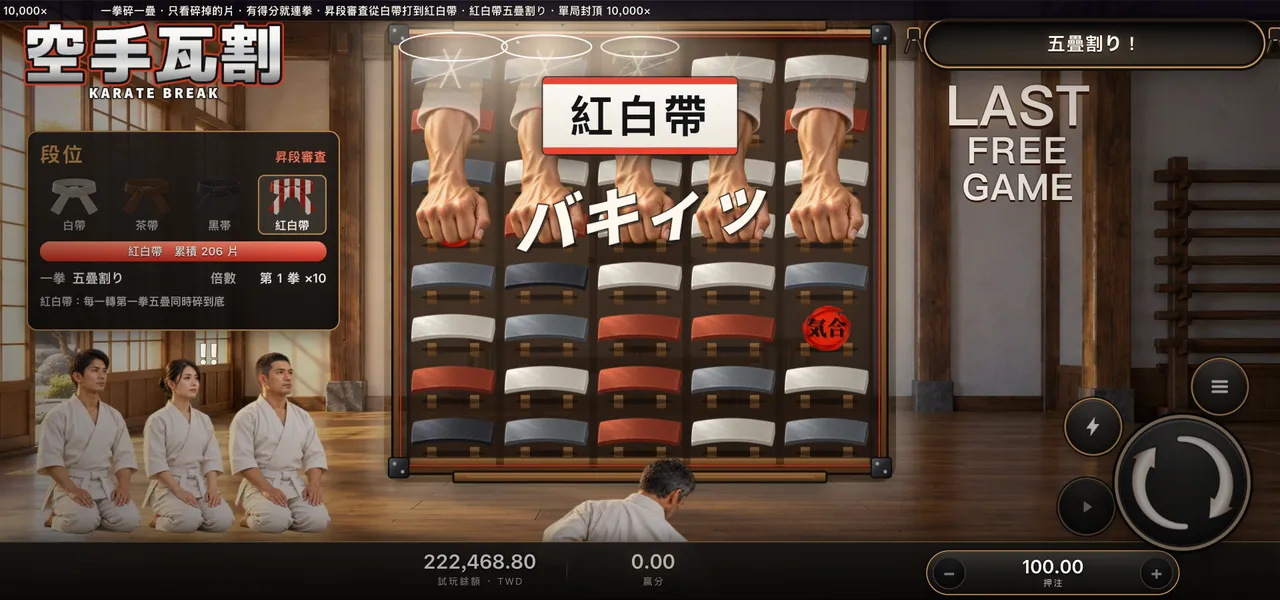
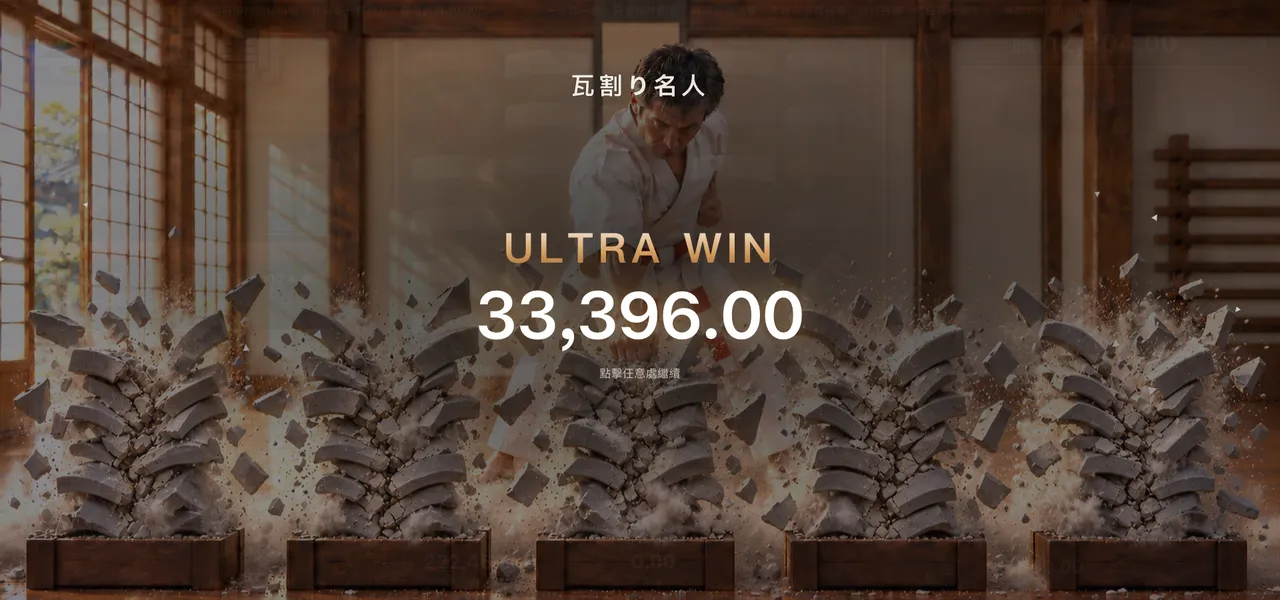
Karate Break — Red-and-white belt — five-stack break
Red-and-white belt — five-stack breakGrading climbs to the red-and-white belt and the first punch breaks every stack at once, ×10.
Karate Break — Big win
Big winA single round is capped at 10,000× the bet.
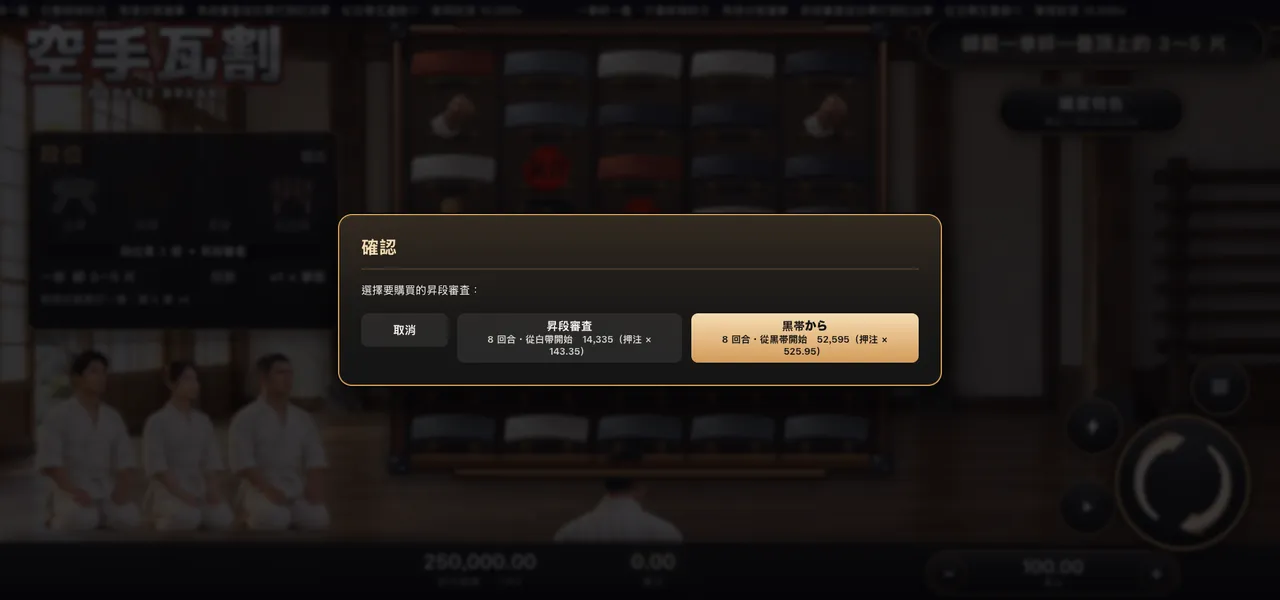
Karate Break — Bonus buy
Bonus buy×143.35 to start grading, or ×525.95 to start on the black belt.
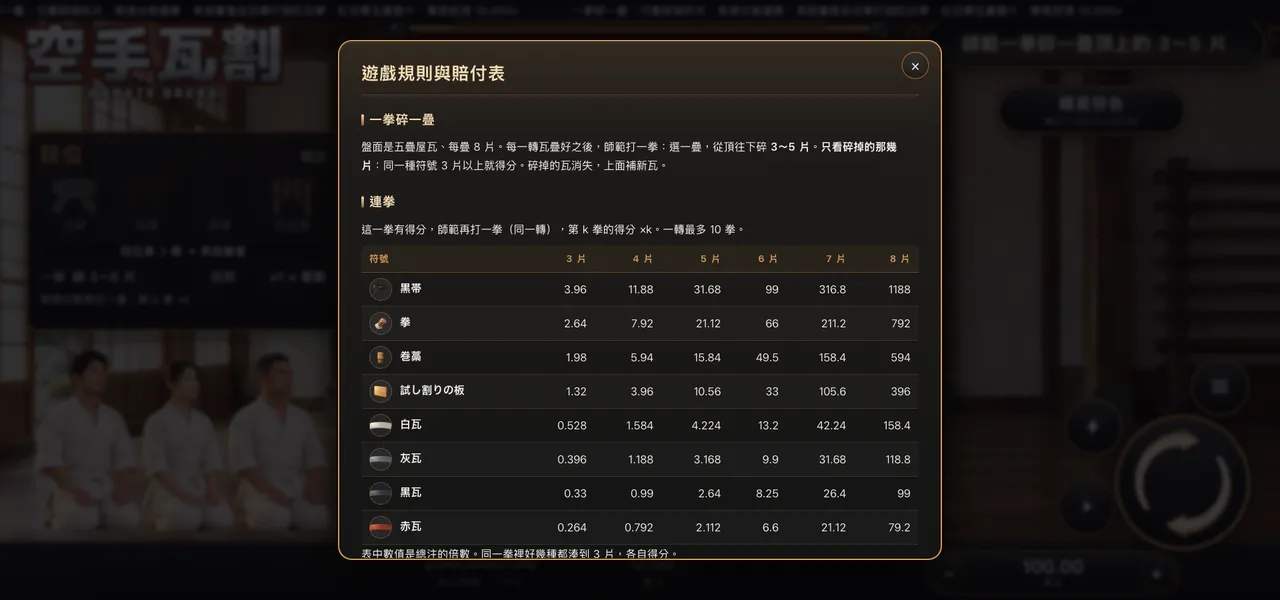
Karate Break — In-game paytable
In-game paytableFrom the same game definition as this page: served by the RGS in game, read at build time here.

Specification

Type5 stacks × 8 tiles grid, broken-tile pays (3+ of a kind among the tiles one punch breaks; broken tiles vanish and new ones refill the top)
Return to player (RTP)96.62%
Bonus buy RTP (Grading)96.62%
Bonus buy RTP (From black belt)96.62%
VolatilityVery high (15.57)
Hit rate29.99%
Rounds winning ≥ 1× bet12.14%
Max win per round10,000× bet
Grading (free spins) frequency≈ 1 in 280.98 spins
RTP verificationExact solution: base game and feature computed exactly (not sampled); the max-win cap's 0.0005 percentage points are estimated by simulation; RTP 96.6180%

Game math specifications and the paytable are read at build time from the definitions shared with the server code. See Math version for the configuration shown; confirm any other version or operator-specific settings separately.

How wins work

  • The grid is 5 stacks of roof tiles, 8 tiles each, with no paylines. Once the stacks are set, the master throws a punch: one stack breaks from the top down, 3–5 tiles deep.
  • Only the broken tiles count: 3 or more of the same symbol pay by count. The kiai wild stands in for any symbol and counts for every kind at once.
  • If the punch wins, the master punches again in the same spin: punch k pays ×k, up to 10 punches. Broken tiles vanish, the rest fall and new tiles refill the top.
  • Rank badges do not pay: 3 or more on the grid when the spin ends start the grading (free spins).

Paytable

Values are multiples of the total bet: a punch pays total bet × table value × punch number (punch k pays ×k) × belt multiplier (always ×1 in the base game). Look up how many of a kind the broken tiles hold (the kiai wild counts for every kind); two kinds broken by one punch both pay.

Symbol345678
Black beltHigh-pay 3.9611.8831.6899316.81188
FistHigh-pay 2.647.9221.1266211.2792
Makiwara postHigh-pay 1.985.9415.8449.5158.4594
Breaking boardHigh-pay 1.323.9610.5633105.6396
White tileLow-pay 0.5281.5844.22413.242.24158.4
Grey tileLow-pay 0.3961.1883.1689.931.68118.8
Black tileLow-pay 0.330.992.648.2526.499
Red tileLow-pay 0.2640.7922.1126.621.1279.2

Special symbols

Kiai

Wild: among the broken tiles, the kiai stands in for any symbol and counts for every kind at once. A punch that breaks only kiai pays as the top symbol.

Rank badge

Scatter, does not pay. 3 or more on the grid when the spin ends start the grading.

Features

One punch, one stack — chain punches

There are no reels: tiles break a stack at a time. Each punch breaks 3–5 tiles from the top of one stack, and only those tiles are matched. Every winning punch earns another, and punch k pays ×k — the longer the chain, the more each punch is worth.

Grading — four belts (free spins)

3/4/5 rank badges award 8/10/12 spins. During grading the broken tiles keep adding up, promoting you at 12/45/200 tiles: white belt ×1 → brown belt ×2 → black belt ×3 → red-and-white belt ×10. Higher belts break more tiles per punch (3–5 on the white belt, 4–6 on the brown belt, 5–7 on the black belt) and multiply every win by the belt; each promotion adds 1 spin.

Red-and-white belt — the five-stack break

From the red-and-white belt, the first punch of every spin breaks all 5 stacks from top to bottom at once. Each stack is matched on its own and wins pay ×10; a win still earns more punches (up to 4, punch k pays ×k again).

Volatility and positioning

Volatility 15.57. The 29.99% hit rate counts any winning round; 12.14% of all rounds return at least the stake. Chain punches carry about 44% of the RTP in the base game; grading comes about once every 280.98 spins and pays more the higher you climb. A single round is capped at 10,000× the bet and ends when it hits the cap. This describes the product's positioning and does not guarantee any single session.

Bonus buy (two tiers)

Pay 143.35× the bet to start grading (8 spins from the white belt, bonus-buy RTP 96.62%), or 525.95× for “From black belt”: 8 spins starting with 45 tiles already broken, straight on the black belt (bonus-buy RTP 96.62%). Both prices follow the expected value of their route and are calibrated separately from regular play.

Technical

Game codeaki_karate
Math versionkt1
TechnologyHTML5, no plug-in; one client for desktop and mobile
ViewportLandscape with proportional scaling
In-game languageTraditional Chinese (additional languages on request)
CurrenciesTWD (others can be registered on request)
IntegrationTransfer wallet (Operator API v3), launch-token redirect

Sources & verification scope

This product specification is written and maintained by its developer, Akitsora Gaming (AKI電子 in Taiwan). Measurement methods and sample information for RTP, volatility and hit rate appear in the specification table. Sampled results have uncertainty; RTP describes long-run return, not an individual player or session outcome.

Internal simulations and tests are not independent certification. We do not currently hold GLI or BMM certification reports. Supply to a market requiring third-party certification depends on completing its requirements.

See slot game development and supply for integration and supply scope, About us for development and content responsibility, or contact us for a math summary, version confirmation or a correction to this page.

The story

Fiction and adapted settings written by Akitsora Gaming for this title, including invented dialogue and events. This is not a historical or folklore reference. The rules and specification tables define the gameplay and math.

Early morning in the dojo, the cypress floorboards freshly wiped clean.
Five tall stacks of grey roof tiles wait as the master draws a single breath.

I. Tameshiwari in the Quiet Dojo

At daybreak the sliding doors of the karate hall stand open to the cool morning air, yet inside the room not a student stirs. Kneeling in straight rows along the wall in white training gi, they watch the centre of the floor where five wooden blocks hold tall stacks of heavy clay roof tiles prepared for tameshiwari—the test of breaking.

Thin wooden spacers separate tile from tile across the five stacks so the force of a blow travels cleanly downward. There are no spinning reels or paylines here; instead, the master steps bare-footed before the stands, centres his breathing, and focuses all his strength into his striking hand.

II. Only the Broken Tiles Count

With a sharp shout, the master drives his fist downward and shatters the top tiles of a chosen stack. The rule of the dojo is simple: only the broken tiles count. If enough matching symbols appear among the shattered pieces, the punch scores a win, aided by wild kiai symbols that count toward every kind of tile at once.

Every winning strike earns an immediate follow-up chain punch within the same spin. As the broken fragments clear and fresh tiles settle onto the top of the stack, the second punch doubles its payout, the third triples it, and the combo continues as long as the punches keep connecting.

III. Grading Through the Belts

When a spin finishes with enough golden rank badges visible on the stacks, the red-and-white dojo banners unfurl for the grading free spins. Starting at white belt, every single roof tile the master shatters is tallied one by one on a cumulative counter throughout the bonus.

Crossing each tile threshold promotes the master to the next rank—from white belt to brown belt, and from brown to black belt. Each promotion awards an extra spin, raises the belt multiplier, and drives every punch deeper into the stack so more tiles shatter at a time.

IV. The Red-and-White Belt Five-Stack Break

At the summit of the grading ladder awaits the grandmaster's red-and-white belt. Once enough tiles have been broken across the round to tie that ceremonial belt around his waist, the master opens every remaining spin with the ultimate technique: the five-stack break.

On that opening strike, all five stacks of roof tiles shatter from top to bottom at the same instant, evaluating each stack separately under the top belt multiplier before any follow-up chain punches begin. It is the game's theme, not a promise: tile breaking and belt promotions belong to martial arts tradition, while every punch is still decided by the RGS random number generator.

Want to spin Karate Break yourself?

The demo needs no account — click and spin. For integration docs, the math summary or sandbox access, send us an email.

Demo play uses virtual credits with no monetary value.