AKITSORA GAMING

Edomae Sushi

At the hinoki counter, one piece after another.

Edomae Sushi is a 6×5 tumbling slot at a hinoki sushi counter. 8+ matching dishes pay anywhere; salmon-roe orbs multiply wins and 4 noren tags trigger free spins.

Demo play uses virtual credits with no monetary value.

RTP
96.70%
Volatility
High11.20
Max win
5,000× bet
Bonus buy
100× bet

In-game screens

Captured straight from the running game — real boards, real wins.

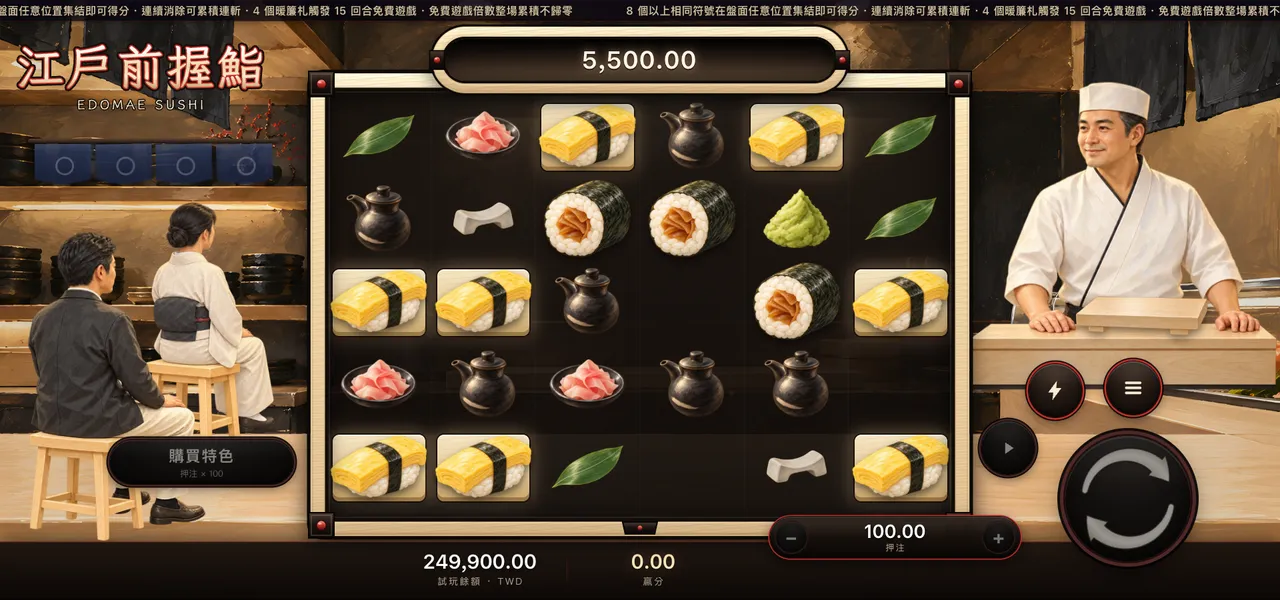
Edomae Sushi — Base game
Base gameA 6 × 5 board. Matching dishes pay anywhere on it.
Edomae Sushi — Cascading win
Cascading winWinning dishes are taken away, new ones drop in, and a single spin can pay several times.
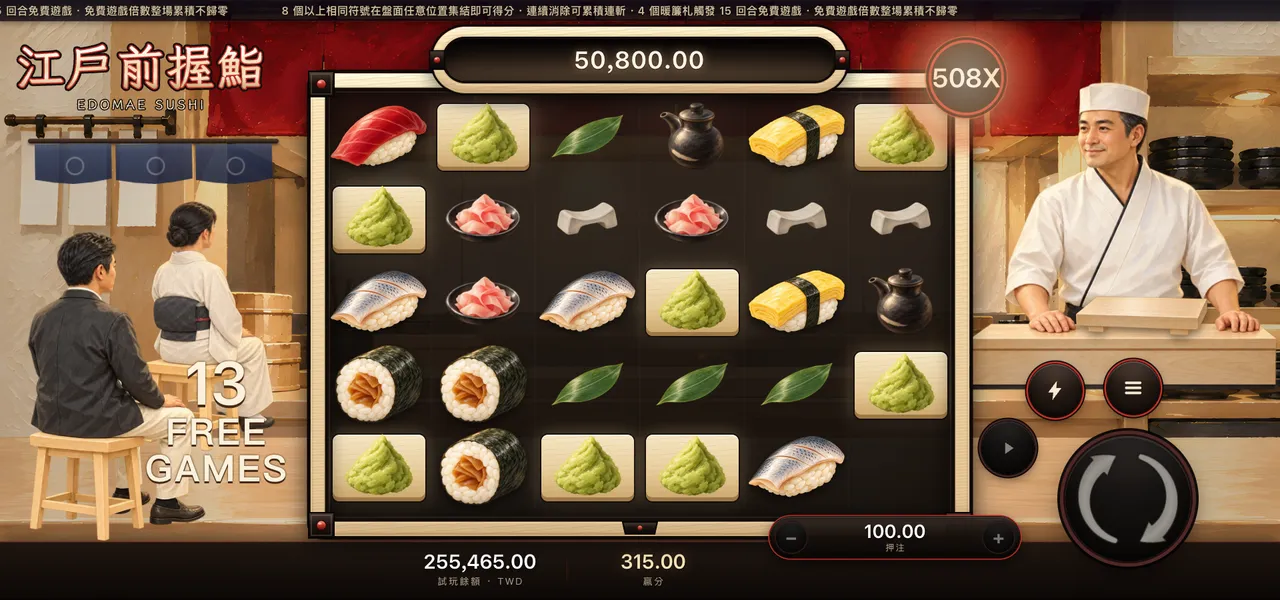
Edomae Sushi — Free spins
Free spinsThe collected multiplier accumulates for the whole feature and applies to the current and every later win.
Edomae Sushi — Big win
Big winA single round is capped at 5,000× the bet.
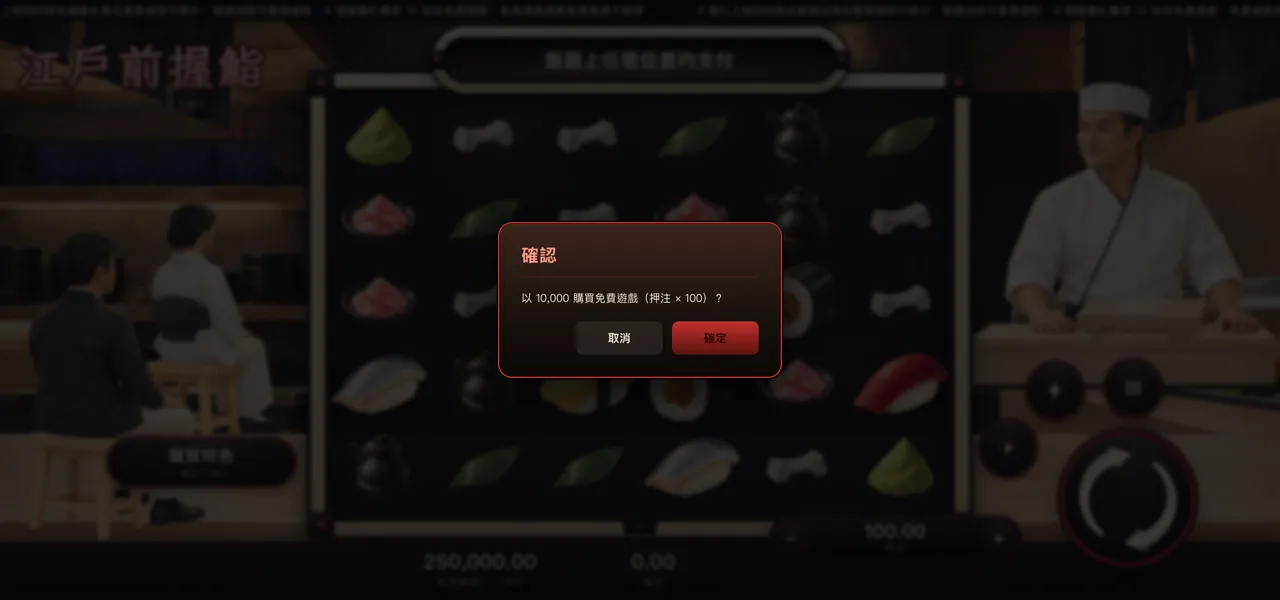
Edomae Sushi — Bonus buy
Bonus buyBuy straight into free spins for 100× the bet. Buy RTP is measured separately.
Edomae Sushi — In-game paytable
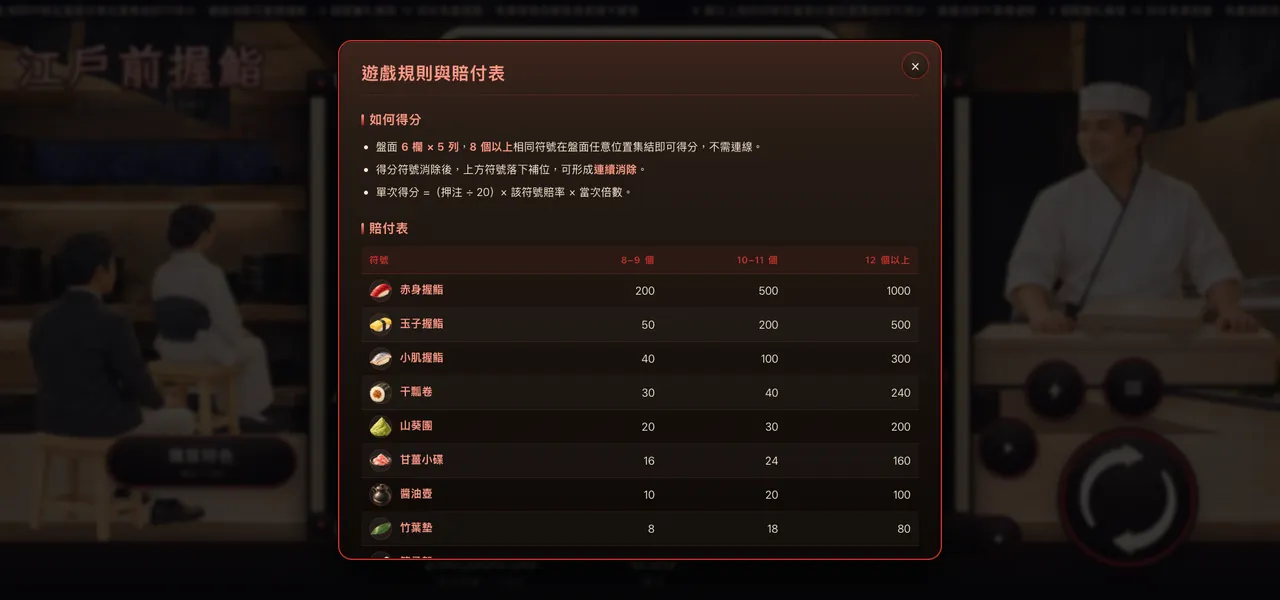
In-game paytableThe same game definition as the table on this page: the game receives it from the server, and this page reads it at build time.

Specification

Type6 × 5 tumble, scatter pays (no paylines)
Return to player (RTP)96.70%
Bonus buy RTP96.41%
VolatilityHigh (11.20)
Hit rate48.97%
Max win per round5,000× bet
Free spins frequency≈ 1 in 214.68 spins
Calibration sample2,240,000,000 spins, standard error 0.02%

Game math specifications and the paytable are read at build time from the definitions shared with the server code. See Math version for the configuration shown; confirm any other version or operator-specific settings separately.

How wins work

  • A 6 × 5 board. 8 or more matching dishes anywhere on it pay — no paylines, no adjacency requirement.
  • Winning dishes are taken away and new ones drop in from above, so a single spin can chain several wins.
  • Each win = (bet ÷ 20) × symbol multiplier × active multiplier.
  • As a rule, at most 2 of the same symbol appear per column, which prevents full-column stacking and keeps clusters spread across the board.

Paytable

Values are the symbol multiplier in: win = (bet ÷ 20) × symbol multiplier × active multiplier.

Symbol8–910–1112+
Akami tuna nigiriHigh-pay 2005001000
Tamago nigiriHigh-pay 50200500
Kohada nigiriHigh-pay 40100300
Kanpyo rollHigh-pay 3040240
WasabiLow-pay 2030200
Pickled ginger dishLow-pay 1624160
Soy sauce potLow-pay 1020100
Bamboo leaf matLow-pay 81880
Chopstick restLow-pay 51540

Special symbols

Noren tag (scatter)

No lines, no adjacency — 4 anywhere on the board trigger the free spins feature.

Salmon-roe orb

Counts when a win lands. Base game ×2–×20, free spins ×2–×500.

Features

Salmon-roe orbs

Counted only when a win lands; the number on the orb is the multiplier. Base game ×2 – ×20. Orbs on the board when a win lands are summed and applied to that cascade's win; they do not carry across cascades.

Free spins

4 noren tags award 15 spins. Orbs in free spins run ×2 – ×500, and the collected multiplier accumulates for the whole feature, applying to the current and every subsequent win.

Retrigger

3 more noren tags during free spins add 5 spins, with the accumulated multiplier carried over.

Bonus buy

Buy directly into free spins for 100× the bet. Bonus buy RTP (96.41%) is measured separately from the base game.

Dry-spin rescue

After 15 consecutive rounds paying less than 1× the bet, the next spin is topped up to a cluster of 8 low-pay symbols — and so is every spin after it until a round pays at least the bet. Only completed rounds still queryable in the live system count; earlier progress may no longer be retained after a long absence. The rescued spin's bet may not exceed the lowest bet of those 15 rounds; at a higher bet that spin is not topped up. Base game only; bonus buys do not count. The RTP in the spec table assumes continuous play of this game at one bet size and includes this feature's contribution (about 2.66 percentage points).

Technical

Game codeaki_edomaesushi
Math versionv96
TechnologyHTML5, no plug-in; one client for desktop and mobile
ViewportLandscape with proportional scaling
In-game languageTraditional Chinese (additional languages on request)
CurrenciesTWD (others can be registered on request)
IntegrationTransfer wallet (Operator API v3), launch-token redirect

Sources & verification scope

This product specification is written and maintained by its developer, Akitsora Gaming (AKI電子 in Taiwan). Measurement methods and sample information for RTP, volatility and hit rate appear in the specification table. Sampled results have uncertainty; RTP describes long-run return, not an individual player or session outcome.

Internal simulations and tests are not independent certification. We do not currently hold GLI or BMM certification reports. Supply to a market requiring third-party certification depends on completing its requirements.

See slot game development and supply for integration and supply scope, About us for development and content responsibility, or contact us for a math summary, version confirmation or a correction to this page.

The story

Fiction and adapted settings written by Akitsora Gaming for this title, including invented dialogue and events. This is not a historical or folklore reference. The rules and specification tables define the gameplay and math.

Ikkan wa, tenohira no ondo de kimaru.
— A piece of sushi is decided by the warmth of the palm. An old saying behind the counter

I. Before opening

Four in the afternoon, and the noren is still folded on its shelf. The chef wipes the hinoki counter for the third time; the wood drinks the water and darkens, and once the lamps come on it will glow back to that pale ivory.

The cold case holds tonight's fish: akami tuna, kohada, a block of tamago, rolls of kanpyo. The rice rests under a cloth, a little cooler than a palm — the rule of this house is that rice must never be hot enough to cook the fish.

II. The two at the counter

There is only the counter. The two on the left tonight are regulars: one in a dark suit, straight from the office; one in a pale kimono who always takes the seat behind, sips her tea first, and then watches the chef's hands.

They never order. They say omakase, and the chef shapes a piece, sets it on the serving board, slides it over — and moves on to the next.

III. Piece after piece

One piece is nothing. 8 or more of the same dish on the counter make a plate — and they do not have to sit side by side.

When a plate is taken, the dishes behind move up, and sometimes the ones that move up make another plate. The regulars say the best nights are the ones when the chef's hands never stop.

IV. The salmon roe

At the back of the cold case is a small bowl of cured salmon roe, each bead glowing like an orange lamp. Now and then the chef sets one on a piece, and that piece is worth the number it glows with.

On an ordinary night the roe counts only for the moment it is placed (×2 to ×20) — once the plate is taken, it is eaten with it.

V. The noren tags

Small noren tags hang by the door, and the chef turns one over for every guest who arrives. 4 turned over at once and it is no ordinary night: the back seating opens, the red noren lifts, and for the next 15 rounds the counter lamps do not dim.

Once the seating is open the roe no longer counts only as it is placed — the beads stack, ×2 to ×500, until the last piece is served. 3 more turned over before the seating closes add another 5 rounds, and nothing already stacked is given back.

VI. O-aiso

The last guest says o-aiso; the chef sets down his hands and gives a small bow. The noren goes back on its shelf, the hinoki is wiped once more, and the counter waits for four o'clock tomorrow.

Want to spin Edomae Sushi yourself?

The demo needs no account — click and spin. For integration docs, the math summary or sandbox access, send us an email.

Demo play uses virtual credits with no monetary value.