
AKITSORA GAMING

Omusubi Roll

Rolling rice balls, all the way down to the mouse palace.

Omusubi Roll is a 3×5 storyteller's slope: rice-ball wilds roll down their reel, and burrows open a pachinko palace where each ball's prize can climb a multiplier ladder.

Demo play uses virtual credits with no monetary value.

RTP
96.79%
Volatility
Medium5.54
Max win
5,000× bet
Bonus buy
63.146× bet

In-game screens

Captured straight from the running game — real boards, real wins.

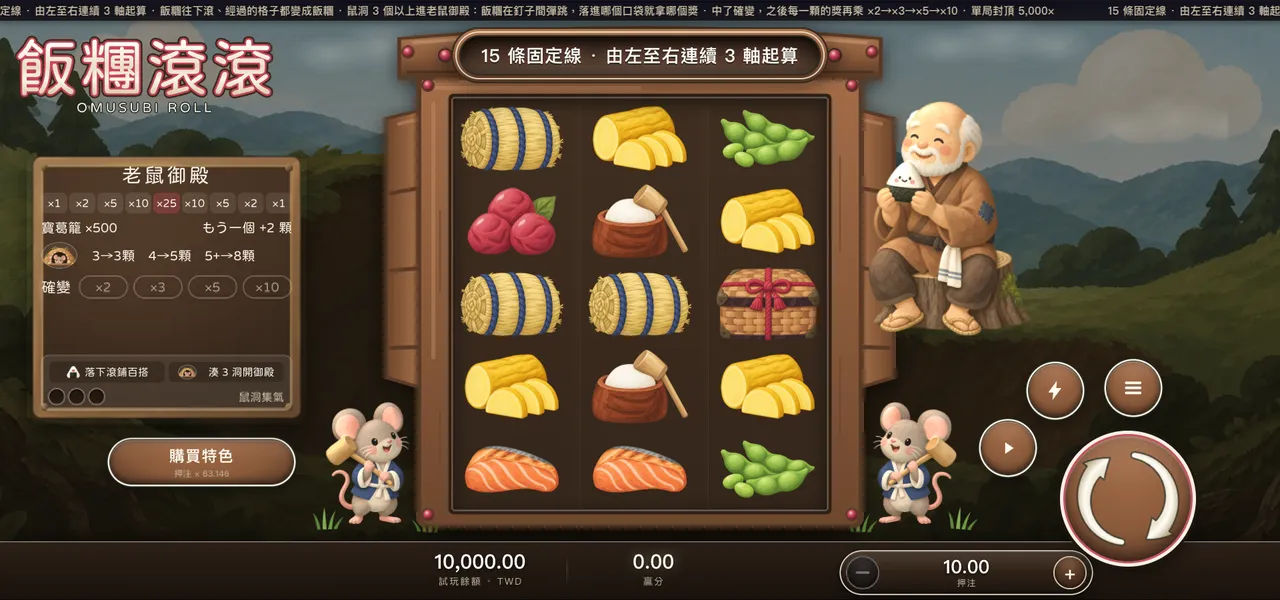
Omusubi Roll — Base game
Base gameA storyteller's picture card: a tall 3 × 5 slope with 15 lines. The old man sits on a stump at the top right; two mice pound mochi at the foot of the grid.
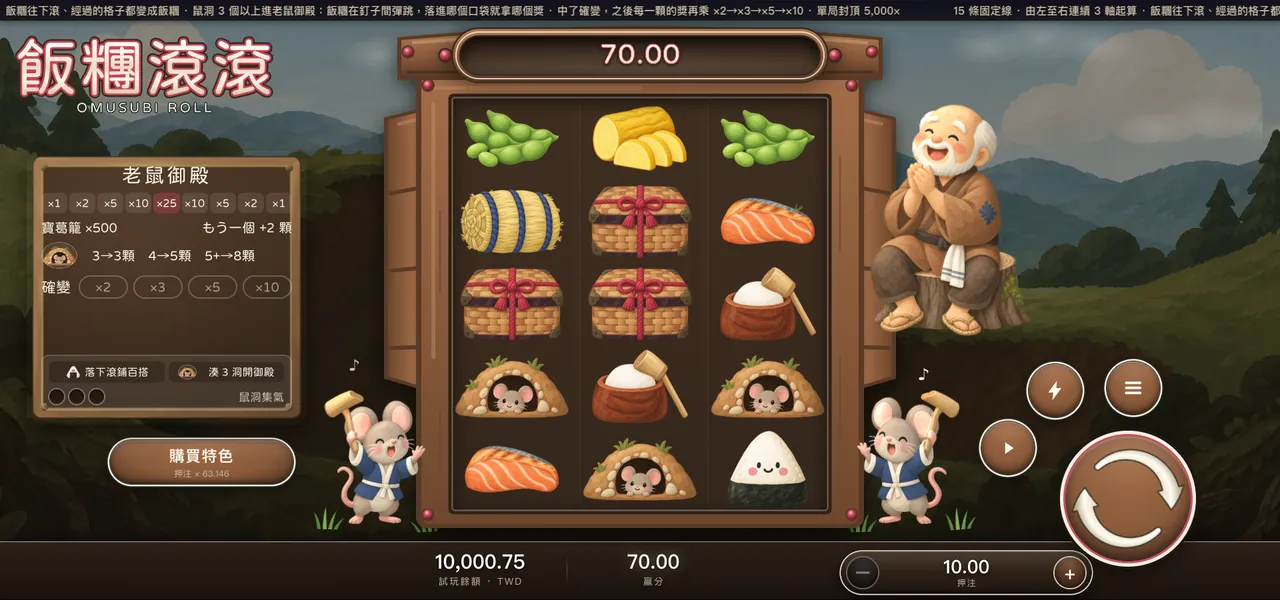
Omusubi Roll — Rolling rice balls
Rolling rice ballsA rice ball rolls all the way down its reel, turning every cell it passes into a wild and linking several lines at once.
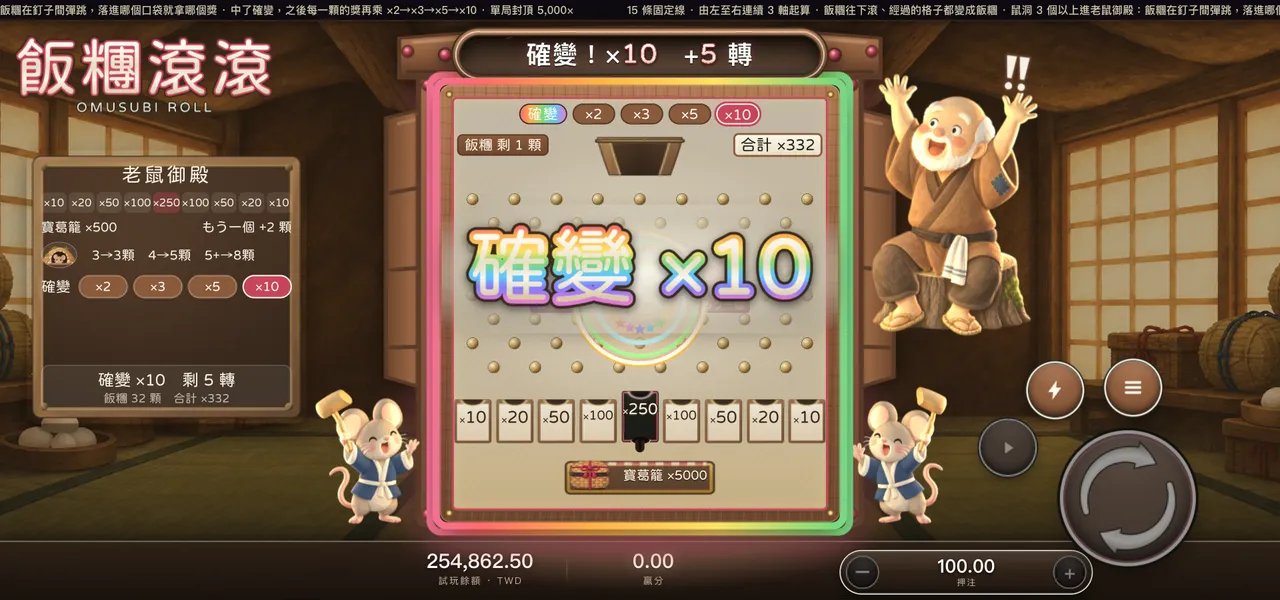
Omusubi Roll — The mouse palace in kakuhen
The mouse palace in kakuhenBalls bounce between the pins into the pockets; with the ladder at ×10, every ball's prize is multiplied.
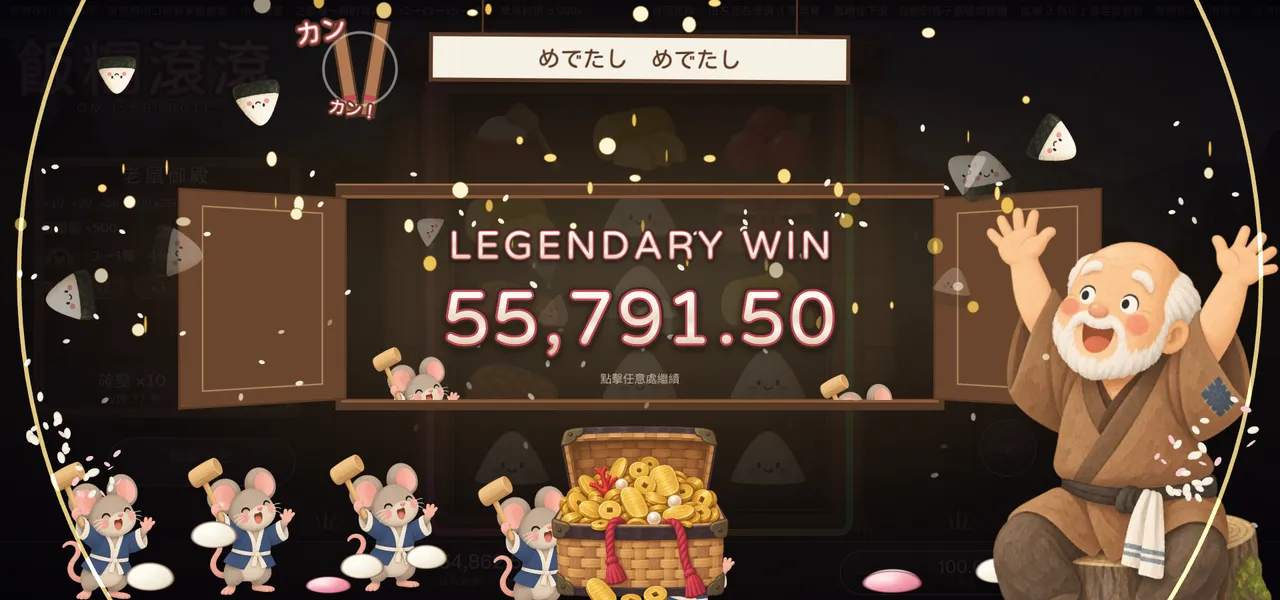
Omusubi Roll — Big win
Big winThe treasure basket at ×10 is exactly the cap: 5,000× the bet per round.
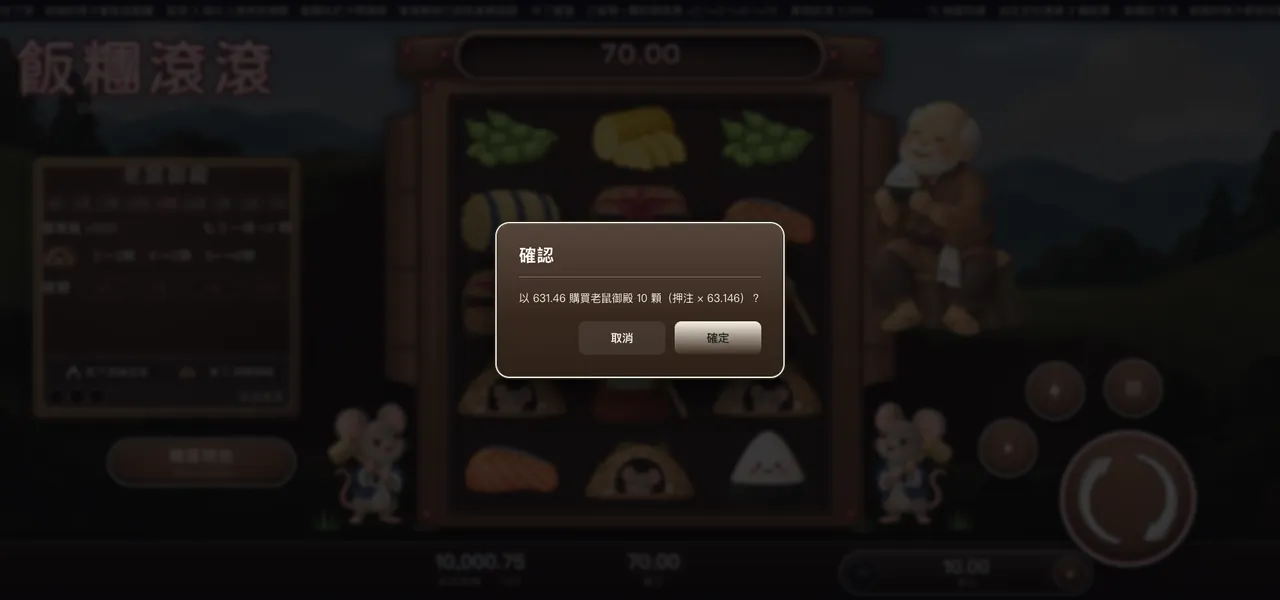
Omusubi Roll — Bonus buy
Bonus buyPay 63.146× the bet to open the mouse palace directly with 10 rice balls.
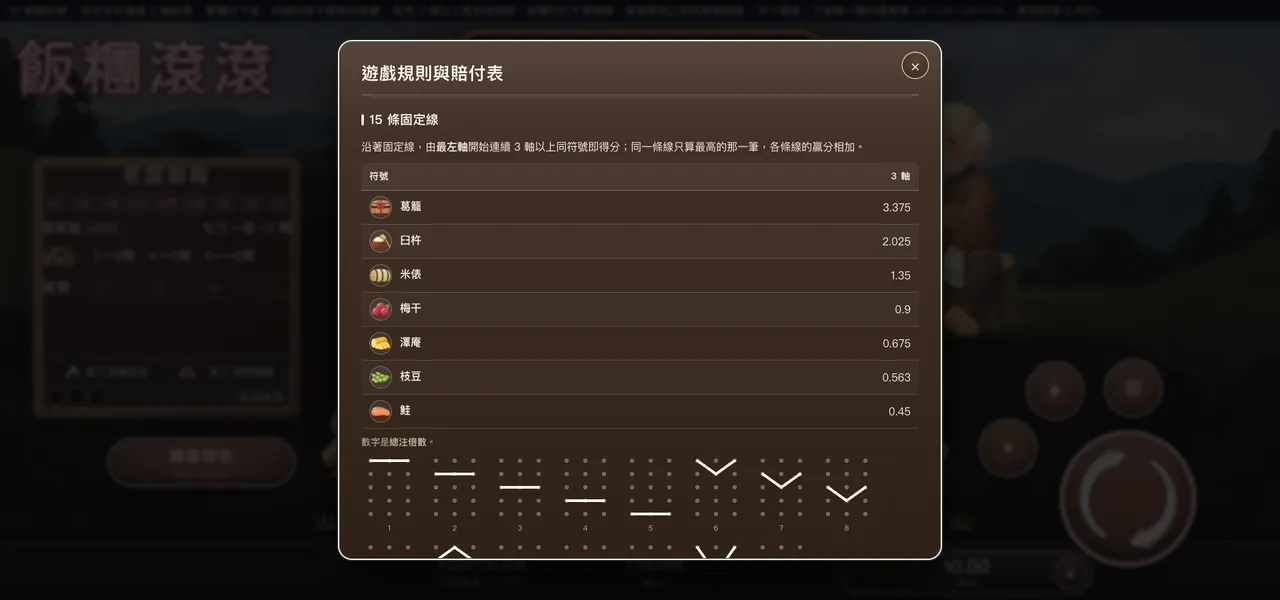
Omusubi Roll — In-game paytable
In-game paytableFrom the same game definition as this page: served by the RGS in game, read at build time here.

Specification

Type3 reels × 5 rows, 15 fixed lines (3 of a kind from the left)
Return to player (RTP)96.79%
Bonus buy RTP96.79%
VolatilityMedium (5.54)
Hit rate28.71%
Rounds winning ≥ 1× bet16.23%
Max win per round5,000× bet
Mouse palace (pachinko) frequency≈ 1 in 41.94 spins
RTP verificationExact solution: base game and feature computed exactly (not sampled); the max-win cap's 0.0005 percentage points are estimated by simulation; RTP 96.7895%

Game math specifications and the paytable are read at build time from the definitions shared with the server code. See Math version for the configuration shown; confirm any other version or operator-specific settings separately.

How wins work

  • The grid is a tall slope: 3 reels × 5 rows with 15 fixed lines; three of a kind from the left pays.
  • The rice ball is a wild for every regular symbol, and it rolls down: every cell below it becomes a rice ball, all the way to the bottom.
  • If a rolling rice ball meets a mouse burrow on the way, it drops in and stops there. It rolls first, then the lines are counted.
  • Mouse burrows count anywhere on the rolled grid: 3 or more open the mouse palace.

Paytable

Values are multiples of the total bet for one line: three of a kind, win = total bet × table value, lines add up (the same numbers as the in-game paytable). A line of three rice balls pays as the basket.

Symbol3 of a kind
Wicker basketHigh-pay 3.375
Mortar and pestleHigh-pay 2.025
Rice baleHigh-pay 1.35
Pickled plumLow-pay 0.9
Takuan pickleLow-pay 0.675
EdamameLow-pay 0.563
SalmonLow-pay 0.45

Special symbols

Rice ball

Wild for every regular symbol. It rolls down its reel, turning every cell it passes into a rice ball, and drops into a burrow if it meets one.

Mouse burrow

Counts anywhere on the rolled grid: 3/4/5+ open the mouse palace with 3/5/8 rice balls. It stops a rolling rice ball.

Features

Rolling wilds

A rice ball rolls down to the bottom of its reel, turning every cell it passes into a rice ball — one ball often fills half a reel. If it meets a burrow it drops in and stops; the burrow and the cells below it stay as they are.

The mouse palace — pachinko

3/4/5+ burrows → 3/5/8 rice balls. The old man drops them one by one into a pachinko board; each bounces between the pins into one of nine pockets: ×1, ×2, ×5, ×10, ×25 (multiples of the total bet, ×25 in the centre). The two side tulips add 2 more balls to the queue, and beside the centre pocket sits a treasure basket worth ×500. The palace opens about once every 41.94 rounds.

Kakuhen — the multiplier ladder

A ball in the centre kakuhen tulip gives +5 kakuhen spins and climbs the ladder ×2 → ×3 → ×5 → ×10; every later ball's prize is multiplied. Each kakuhen spin is a real spin (lines pay as usual) followed by one more ball, and 3+ burrows on that spin drop 3/5/8 extra balls. The treasure basket at ×10 is exactly the 5,000× cap.

Volatility — positioning

Volatility 5.54. Hit rate 28.71% counts rounds with any win; 16.23% of all rounds return at least the stake. The base game carries about 55% of the RTP; the palace comes often in moderate portions, and the kakuhen ladder is the long tail. Capped at 5,000× the bet per round. “Kakuhen” only borrows the pachinko name: where every ball lands is decided by the server's RNG. This describes the product's positioning and does not guarantee session outcomes.

Bonus buy

Pay 63.146× the bet to open the mouse palace directly with 10 rice balls (more than any natural trigger). The price comes from the expected value measured along that path (buy RTP 96.79%) and is calibrated separately from the base game.

Technical

Game codeaki_omusubi
Math versionom1
TechnologyHTML5, no plug-in; one client for desktop and mobile
ViewportLandscape with proportional scaling
In-game languageTraditional Chinese (additional languages on request)
CurrenciesTWD (others can be registered on request)
IntegrationTransfer wallet (Operator API v3), launch-token redirect

Sources & verification scope

This product specification is written and maintained by its developer, Akitsora Gaming (AKI電子 in Taiwan). Measurement methods and sample information for RTP, volatility and hit rate appear in the specification table. Sampled results have uncertainty; RTP describes long-run return, not an individual player or session outcome.

Internal simulations and tests are not independent certification. We do not currently hold GLI or BMM certification reports. Supply to a market requiring third-party certification depends on completing its requirements.

See slot game development and supply for integration and supply scope, About us for development and content responsibility, or contact us for a math summary, version confirmation or a correction to this page.

The story

Fiction and adapted settings written by Akitsora Gaming for this title, including invented dialogue and events. This is not a historical or folklore reference. The rules and specification tables define the gameplay and math.

A nori-wrapped rice ball slips from the hilltop stump,
rolling korori, suttonton, all the way down to the underground mouse palace.

I. Noon Lunch on the Woodcutter's Slope

Long, long ago, a kind-hearted old woodcutter climbed into the hills every morning to gather firewood among the pines. When noon arrived, he sat down on a mossy tree stump high on the slope and unfolded the bamboo wrapper holding the plump white rice balls his wife had lovingly shaped for his lunch. A gentle mountain breeze rustles through the green bamboo grove while birds sing high in the branches overhead.

Before he could even take a bite, one round rice ball slipped from his fingers — korori, korori — and tumbled straight down the steep hillside. The game's tall grid is that very slope: whenever a rice ball wild lands, it rolls down its reel and turns every cell along its path into a wild. Watching a single rice ball tumble all the way down the slope brings the playful rhythm of the old folktale to every spin.

II. A Song Rising from the Burrow

Instead of stopping in the grass, the rolling rice ball dropped — suttonton! — right into a little mouse burrow beside the old tree roots. When the woodcutter knelt down on the hillside to peer inside, he heard tiny voices singing a cheerful tune from deep underground: “Omusubi korori, suttonton!” The cheerful rhythm of their underground song echoes up through the roots, inviting the curious woodcutter to follow.

Leaning closer to listen to the song, the old man lost his footing on the moss and tumbled down the hole himself. On the reels, a mouse burrow catches any rice ball rolling from above, and landing enough burrows on the finished board opens the doors to the mouse palace below. Stepping through that tiny burrow transforms the quiet mountain hillside into a bustling festival beneath the earth.

III. Bouncing Through the Mouse Palace

At the bottom of the tunnel stood a grand underground palace where grateful mice in festive coats were pounding mochi with wooden mallets and singing in the woodcutter's honour. In the game, their lantern-lit hall comes to life as a classic wooden pachinko parlour framed like a street-corner paper theatre. Warm paper lanterns and festive banners line the timber walls as the mice welcome their guest to the grand hall.

The old man drops his rice balls one by one into the brass pin field, watching each ball clatter and bounce toward the nine prize pockets at the bottom — or into the two side tulips that add extra rice balls to the queue so the run keeps going. Every bounce against the gleaming brass pins keeps the suspense alive until the rice ball finally settles into a pocket.

IV. The Wicker Basket of Gold Coins

Whenever a bouncing rice ball drops straight into the central kakuhen tulip, red lanterns flare across the palace hall: extra reel spins are awarded on the spot and the multiplier ladder climbs a full rung, boosting the payout of every rice ball that falls afterward. The festive music grows livelier with every rung climbed on the ladder, filling the underground hall with golden light.

Right beside the centre pocket sits the mice's parting gift to the kind old woodcutter — a woven treasure basket brimming with gold koban coins. Climbing to the top of the multiplier ladder and dropping a rice ball into that basket crowns the folktale with its richest reward. Just as in the beloved fireside story, a simple act of kindness on the hillside leads to an overflowing basket of gold.

Want to spin Omusubi Roll yourself?

The demo needs no account — click and spin. For integration docs, the math summary or sandbox access, send us an email.

Demo play uses virtual credits with no monetary value.