




The story
Fiction and adapted settings written by Akitsora Gaming for this title, including invented dialogue and events. This is not a historical or folklore reference. The rules and specification tables define the gameplay and math.
New Year in the tatami hall, a box of poem cards before a gold screen.
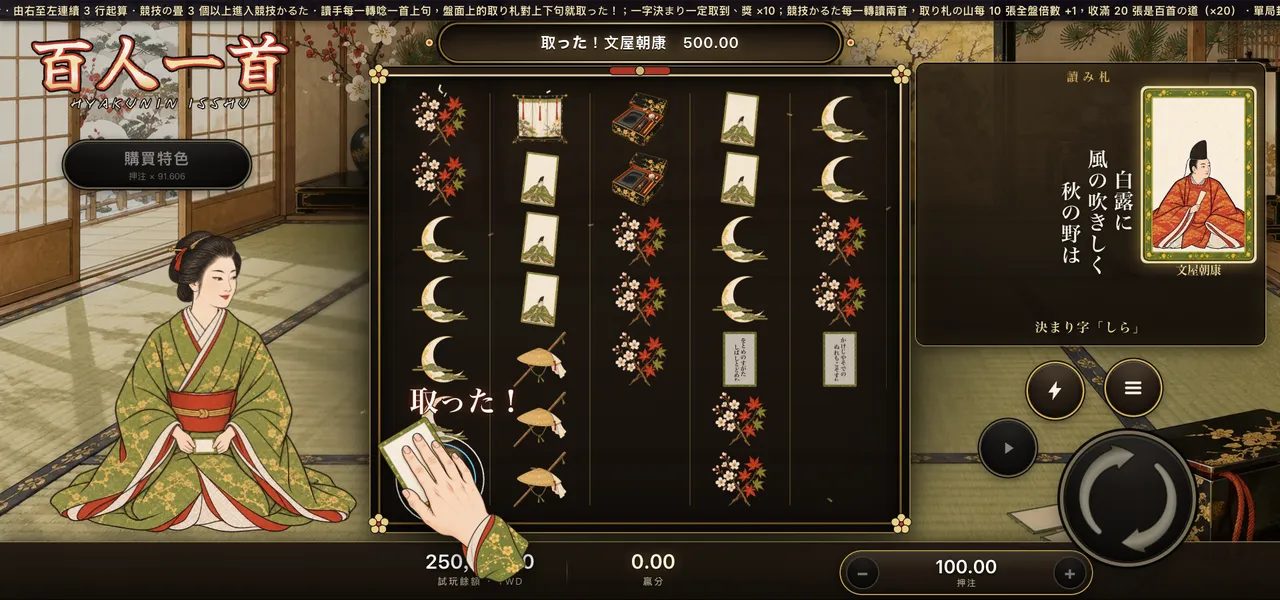
At the reader's very first syllable, a hand is already sweeping across the mat.
I. One Hundred Poems in Vertical Lines
In the early Kamakura period, the court poet Fujiwara no Teika selected one hundred classical waka—one verse each from a hundred master poets—to adorn the walls of his villa at Mount Ogura. Centuries later those verses became Hyakunin Isshu karuta: painted reading cards bearing the poet's portrait and opening lines, paired with kana grabbing cards spread across the tatami.
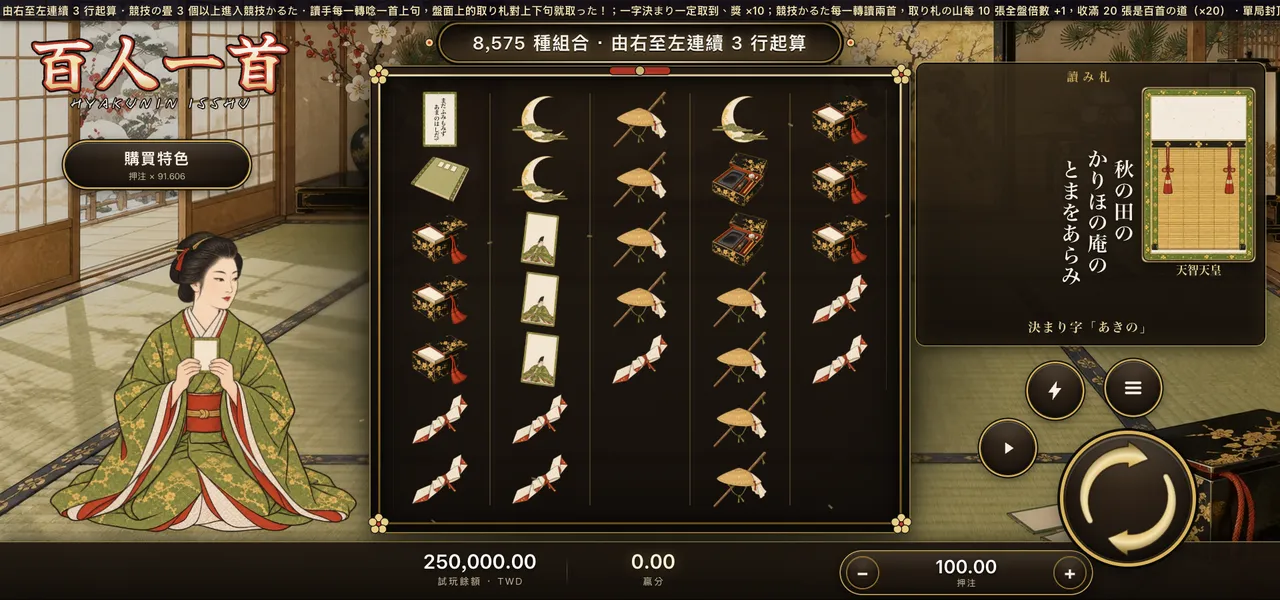
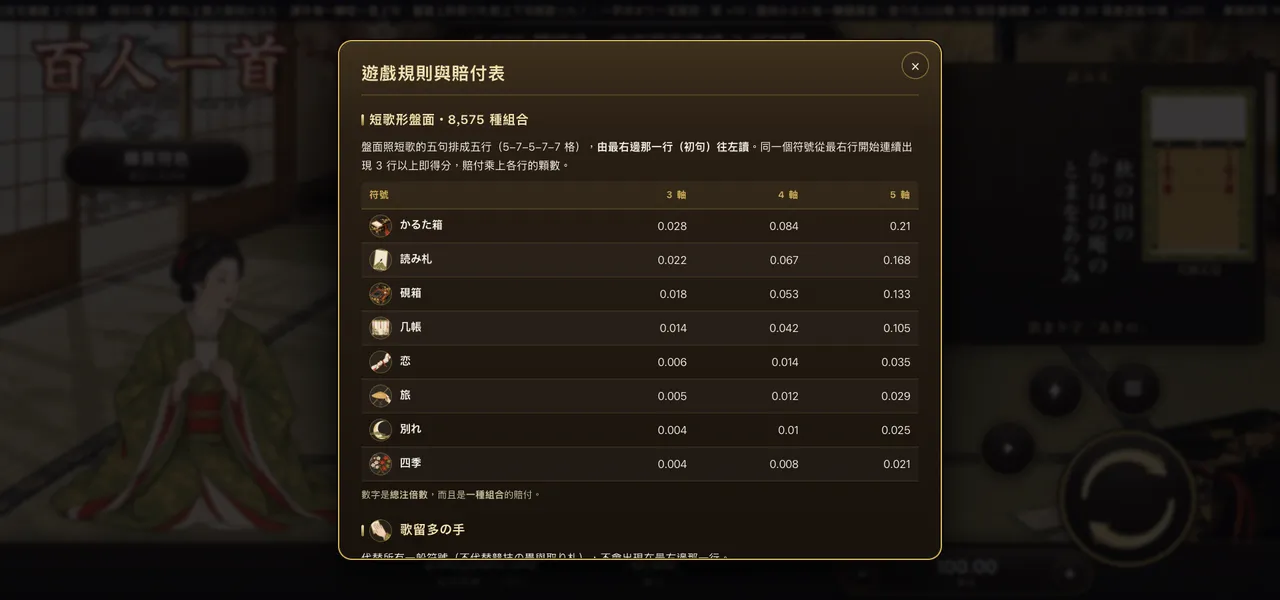
True to classical Japanese verse, the game board is arranged in the five-seven-five-seven-seven rhythm of a five-line tanka poem and reads from the rightmost line toward the left, with the swift karuta hand acting as a wild symbol along the way to join consecutive lines across the mat.
II. The Reader's Voice and the Matching Card
At the start of every spin, the reader intones the opening phrase of one poem from the hundred-verse anthology while its poet appears on the reading card at the top right of the screen. Meanwhile, wooden-edged grabbing cards inscribed with closing verses in flowing kana script land across the vertical lines.
If a card on the board carries the closing verse of the exact poem being chanted, the player's hand snaps it up with a crisp slap across the woven mat, awarding an instant prize scaled by the poem's deciding syllables while non-matching cards remain harmless decoys.
III. Seven Poems Decided in a Single Sound
In competitive karuta, players memorize the exact syllable at which each opening verse becomes unique among all one hundred poems. Seven famous verses—remembered by the syllables mu, su, me, fu, sa, ho, and se—are one-syllable poems whose identity is certain the instant the reader's lips form the very first sound.
Whenever the reader calls one of those seven one-syllable poems in the base game, its matching grabbing card always lands on the board and is struck immediately in a lightning-fast reflex take, multiplying its prize for the biggest instant moment in regular play before the next verse begins.
IV. The Card Pile and the Hundred-Poem Road
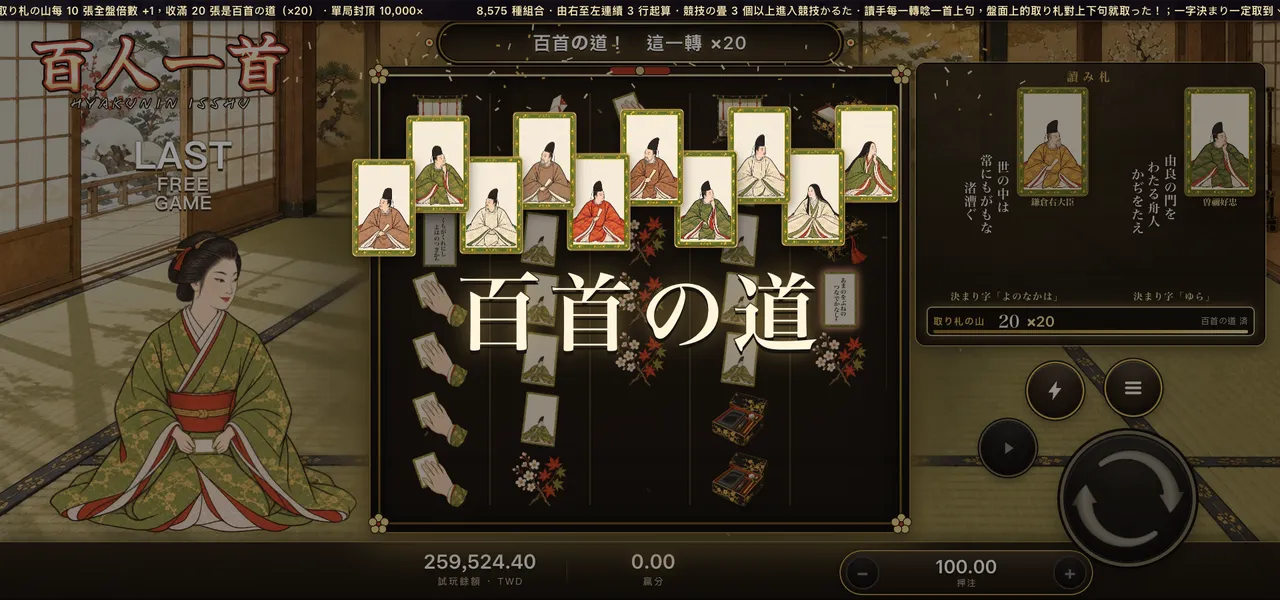
Landing enough woven competition tatami scatters starts the Competition karuta bonus, where the reader chants two poems on every single spin. Every card you grab is stacked onto your card pile beside the mat, and every few cards added raises the whole-board multiplier for the rest of the match without limit.
Stacking enough cards in a single match unlocks the Road of a Hundred Poems, multiplying that entire spin once more while the pile keeps growing afterwards. It is the game's theme, not a promise: the art of karuta belongs to poetic tradition, while every spin's outcome is still decided by the RGS random number generator.