








The story
Fiction and adapted settings written by Akitsora Gaming for this title, including invented dialogue and events. This is not a historical or folklore reference. The rules and specification tables define the gameplay and math.
Morning mist lifts from Nihonbashi as Yaji and Kita set out along the highway.
Through mountain passes and sudden showers, fifty-three stations lead to Kyoto’s bridge.
I. Setting Out from Nihonbashi
Every great journey out of old Edo began at the timber arches of Nihonbashi in the early morning mist. Here two cheerfully hapless Edo townsmen—Yajirobei and Kitahachi—tie their woven straw sandals, hoist their cloth bundles onto their shoulders, and vow to walk the entire coastal highway all the way to the temples of Kyoto. Straw sandals kick up morning dust along the pine-lined highway as travelers trade stories between mountain passes and coastal bays.
Immortalized in Jippensha Ikku’s classic comic novel Tokaidochu Hizakurige, the pair travel on foot by “shank’s mare,” stumbling from one roadside misadventure to the next at every post town—sampling local delicacies, tipping too many cups of warm sake, and leaving far more laughter than footprints along the busy road. Woodblock-inspired vistas of Mount Fuji and post-town inns frame every stride of the historic journey from Edo to Kyoto.
II. Prints of Fifty-Three Stations
Stretching between Edo and the imperial capital lay fifty-three post stations where weary travelers rested and changed horses. Master printmaker Utagawa Hiroshige captured every stop in his celebrated woodblock series: coastal dawn at Shinagawa, steep crags at Hakone, silent night snow at Kambara, and driving white rain bending the bamboo at Shono. Straw sandals kick up morning dust along the pine-lined highway as travelers trade stories between mountain passes and coastal bays.
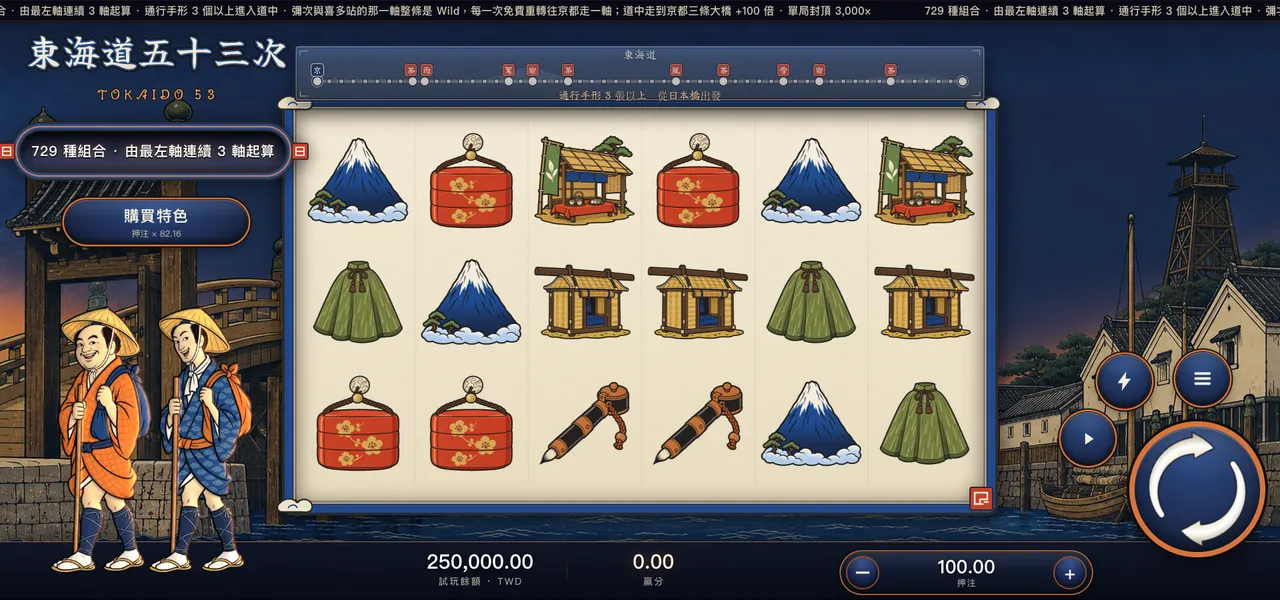
Across this five-reel, three-row all-ways grid, snow-capped Mount Fuji, timbered inns, express palanquins, and roadside teahouses spin alongside the travelers’ portable brush cases, lacquer inro, straw rain capes, and oiled paper umbrellas, all rendered in crisp ukiyo-e woodblock lines beneath a hand-brushed Bokashi sky. Woodblock-inspired vistas of Mount Fuji and post-town inns frame every stride of the historic journey from Edo to Kyoto.
III. Walking Wilds Heading West
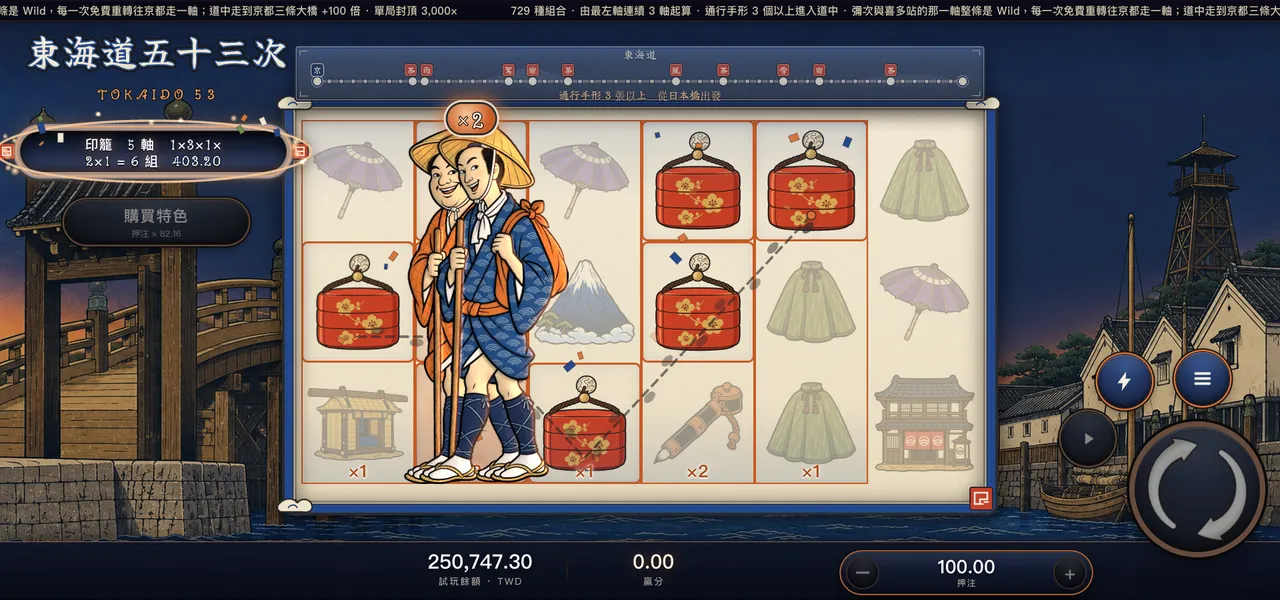
Whenever Yaji or Kita lands on the right half of the board, the traveler stands tall to fill the entire reel as a Wild, then strides one column leftward on each consecutive free respin until he walks off the western edge of the screen—bringing more free respins the further right his journey begins. Straw sandals kick up morning dust along the pine-lined highway as travelers trade stories between mountain passes and coastal bays.
Should both companions land on the very same column at once, they travel side by side: every cell on their shared reel carries a boosted pair multiplier as they march across the board together, turning a chance meeting on the Tokaido road into a rich windfall of ways combinations. Woodblock-inspired vistas of Mount Fuji and post-town inns frame every stride of the historic journey from Edo to Kyoto.
IV. Arrival at Sanjo Bridge in Kyoto
Gathering enough wooden Travel Pass scatters opens the barrier gate for the Fifty-Three Stations journey feature. Setting off side by side from Nihonbashi, every step a traveler takes advances the route map across famous stations—stopping at teahouses for extra spins, post towns and tailwinds to raise the journey multiplier, express palanquins to leap ahead, and sudden showers that wash low symbols from the reels.
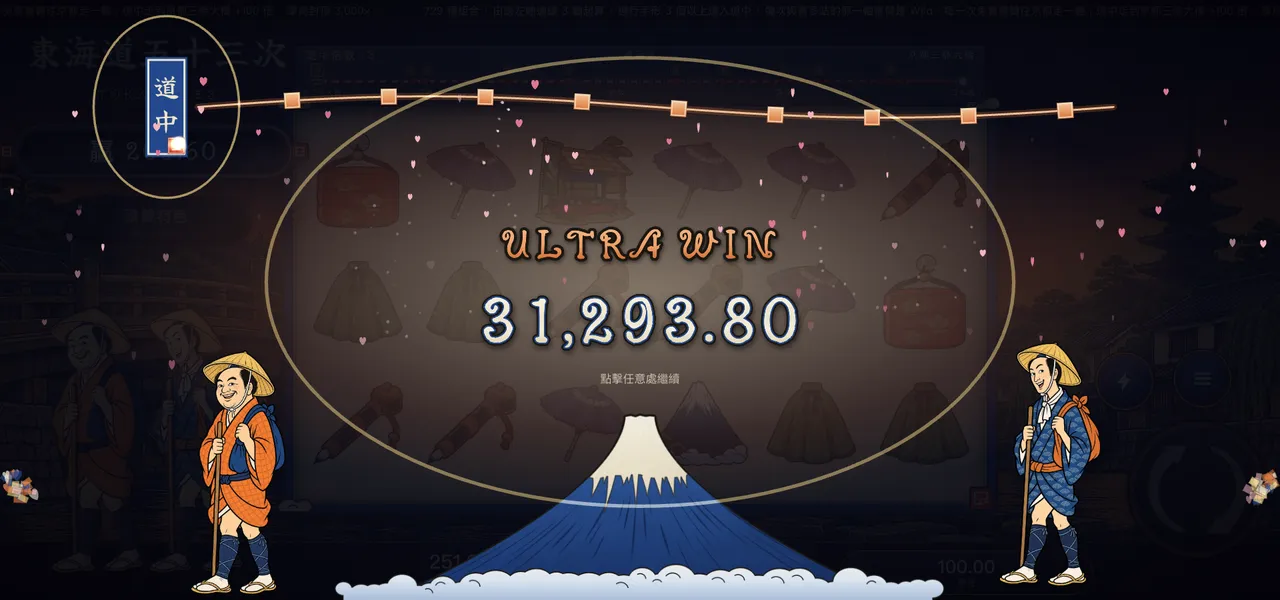
The moment their footsteps reach Sanjo Bridge in Kyoto, an instant arrival prize is awarded and every ways win for the rest of the journey is multiplied again by the Kyoto goal multiplier. Leaping high to slap hands on the wooden bridge, the two old friends turn a long road into a grand finale. Woodblock-inspired vistas of Mount Fuji and post-town inns frame every stride of the historic journey from Edo to Kyoto.